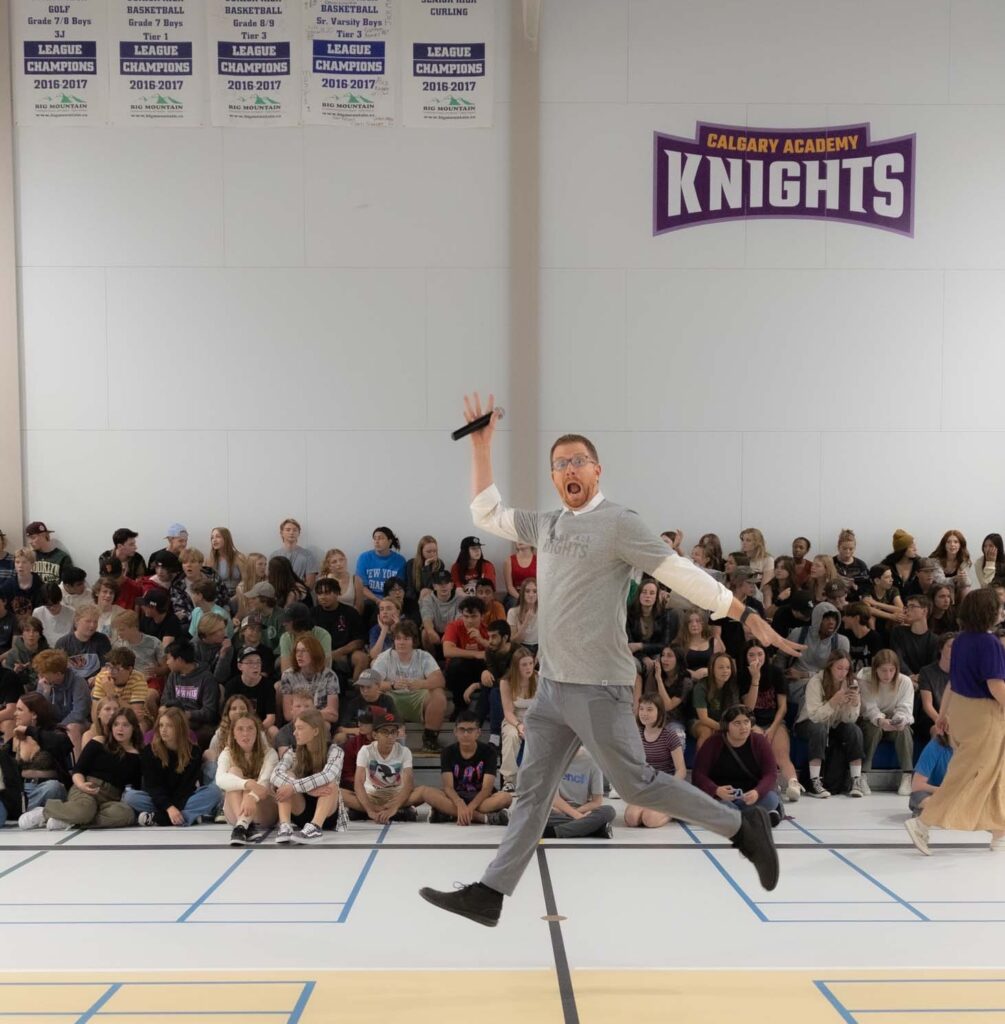
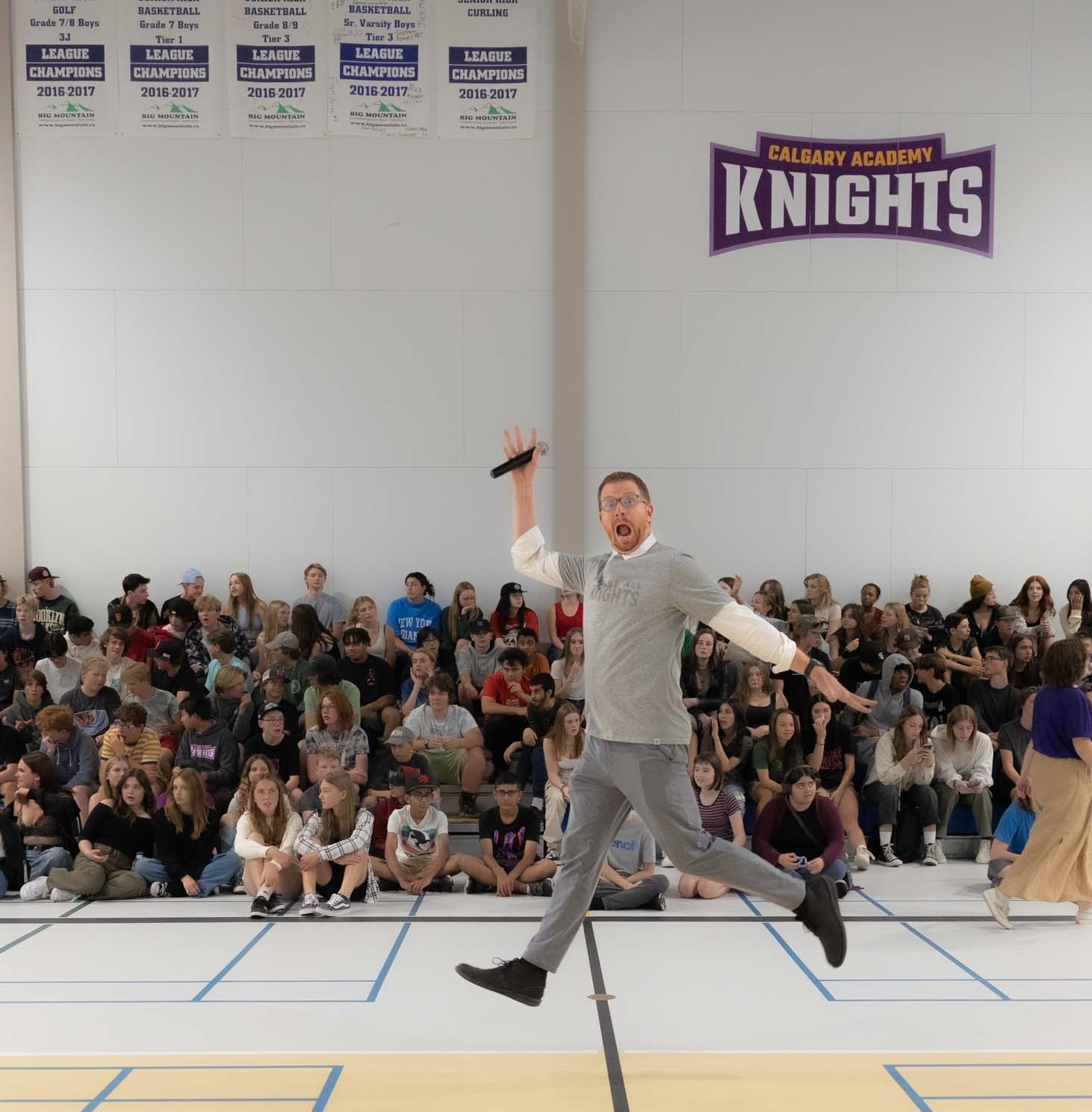
One of the most prominent faces at Calgary Academy is Principal Timothy Carlson. You can find him everywhere around the school, visiting classrooms, meeting with other teachers, or running the microphone at many school events.
He has seen Calgary Academy grow (in student population, square footage, and programs offered), but the school’s philosophy has remained the same—placing the individual needs of each student first.
Currently in his 24th year at the school, Dr. Carlson reflects on his time at CA, his recently completed doctorate, and the school’s future.
Finding a Community
Dr. Carlson’s first day at Calgary Academy was in 2002. Moving from British Columbia, he jumped into teaching Grade 12 students, helping them prepare for life after graduation. He was in a new province, managing a long-distance relationship with his girlfriend (now his wife), and trying to find his footing.
While transitioning from the BC to Alberta education curriculum had its challenges, Dr. Carlson was fortunate to have many colleagues and mentors to lean on.
“I taught with people who had been around a while, who were excellent teachers… There was a really wonderful community in the high school, and I just fit in well.” – Dr. Carlson
He spent his first year working closely with the Grade 12 students, a graduating class of around 60 students. The school community is what first stood out and continues to impress Dr. Carlson over two decades later.
“I felt a part of the community very quickly, and I loved helping students have their needs met.”
The school he has called home has evolved with time, but CA’s heart and fundamentals have stayed the same. In his early teaching days, you could step into any classroom and see similarly structured lessons. He notes that the same instruction remains today, just delivered in more flexible and modern ways.
Eventually, he became the school principal, a position he has now held for years. While he wasn’t always planning on becoming a leader in the school, Dr. Carlson took the opportunity when it presented itself and learned a lot from his colleagues—how they approach and help others and cultivate a supportive community.
“Probably the biggest challenge of leadership in a school is that it’s people with different personalities, strengths, and areas of growth. Understanding the people you work with and supporting them, I’ve always thought, is the core of leadership.” – Dr. Carlson
Looking to the Future
Recently, Dr. Carlson earned his doctorate in education, capping off years of study and a successful defence of his thesis. He had never seen himself as someone to pursue a doctorate. He didn’t consider himself an “academic,” but felt inspired seeing his colleagues pursuing theirs.
 Dr. Carlson was always interested in learning and improving himself as an educator. With encouragement from others at CA, he took the plunge, spending several years balancing research, coursework, and his regular day-to-day at the school.
“For me, it was always about learning. What more can I learn? I don’t really have an endpoint… What drove me to do my doctorate was the encouragement from our CEO, Dr. Greg Bass, and seeing others doing it too.”
Dr. Carlson gained a deeper understanding of himself, leadership (his research focus), and the world of education during his doctoral studies. The assistive technology his professors recommended was the same as that utilized daily at Calgary Academy—a hint of what the future of education could be.
Education has changed a lot since Dr. Carlson first started teaching at the school, and he is excited to see how it (and Calgary Academy) continues to adapt and grow. He understands that every learner is unique and hopes to see personalized learning continue to thrive.
“If you could get more personalized learning and a flexible approach to learning for you, there’s a ton of interesting things coming up. I think that if we keep our eyes open and look around the world, Calgary Academy can also jump into those areas, because we know the brain well. We understand how learners learn.”