

Welcome to June! I don’t know about you, but for me, this school year has zipped by so quickly. It is hard to believe it is almost summer break.
I know that many of these newsletters have focused on anxiety, and I would like to continue talking about how we, as parents, can best support our children who struggle in this area, especially as we head into the summer months. I recently attended a two-day conference based on a parent program called SPACE (Supportive Parenting for Anxious Childhood Emotions). SPACE was developed by Eli Lebowitz, and since I previously read his book, Breaking Free of Childhood Anxiety and OCD, I was excited to take this training. I would like to share some key points of this training with you.
According to their website, “parents who participate in SPACE will learn skills and tools to help their child overcome anxiety, OCD or related problems. The treatment focuses on changes that parents can make to their own behaviour; they do not need to make their child change. The two main changes that parents learn to make in SPACE treatment are to respond more supportively to their anxious child and to reduce the accommodations they have been making to the child’s symptoms.”
According to SPACE, there are two common (and not so helpful) responses that parents may have to their child’s fears: protecting and demanding.
Protecting
- Thoughts and behaviours that centre around the goal of protecting our child from harm or distress. Becoming “the protector” when our child isn’t really in danger.
- Communicates that the worry really is THAT big and that our children can’t cope with it.
- Reinforces the anxious belief.
- Prevents our children from having the opportunity to see if the fear was actually warranted.
- Things we might think and say: “My job as a parent is to make my child’s life as comfortable as possible. I want to help my child feel good all the time. They shouldn’t have to struggle.”
Demanding
- When we expect our child not to feel anxious, or to act as if they are not feeling that way.
- Demanding that our child feel and do differently in a subtle (“no, honey, this isn’t actually scary”) or a more extreme way (“stop being such a baby”)
- Things we might think or say: “He’s just looking for attention. Stop being so dramatic! See, this is not scary!”
How do we help our children then? By offering support:
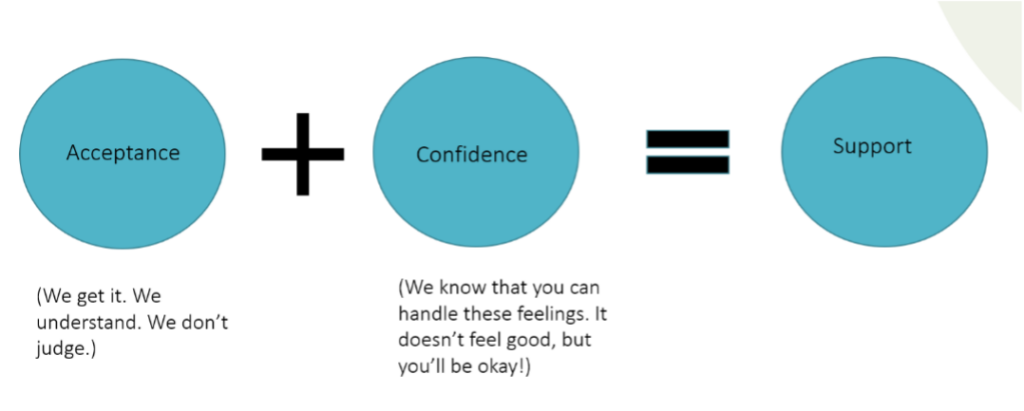
We communicate acceptance and validation of their feelings (even if they don’t make sense to us), and we express confidence that they can get through this moment of fear and anxiety.
In addition to protecting and demanding, most families of children with anxiety engage in accommodations that only make the anxiety worse. Accommodations are changes parents make in their own behaviour to help their children avoid or lessen feelings of anxiety. For example:
- Letting our child stay home because they feel anxious (anxiety does present somatically, so they might truly feel sick. We have to remember that it’s not dangerous, just uncomfortable.)
- Answering every text message/phone call and providing reassurance.
- Waiting in the parking lot in case our child wants to go home.
- Asking a teacher to postpone a test because our child is too anxious.
- Letting them sleep with us because they are afraid to be away from us.
- Following them from room to room because they don’t want to be alone.
Remember, the opposite of accommodation is “normal.” If you are not sure how you are accommodating, ask yourself the following:
- Is this something I do because of my child’s anxiety?
- Does my child become more anxious if I don’t do it?
- Do I do the same for my other children? Would I do it for another child?
- Do I feel as though I have no choice but to do this?
- Do most people do this for their child at this stage?
- Have I tried to stop it?
If you have a child with anxiety, I encourage you to take some time this summer to observe the way in which you respond to their fears and worries. Are you protecting? Demanding? What accommodations are in place? What is one accommodation you could change/remove? And remember, it is in our nature to want to help our children. Through this process of noticing, we are trying to recognize the things we have done to help our child (and our family) get through the day.
Once (or even before) you have identified these accommodations, I encourage you to access Eli Lebowitz’s book Breaking Free of Childhood Anxiety and OCD, as he breaks down the next steps in reducing/removing accommodations. He provides guidelines for choosing which accommodation to tackle and explains how to express this information to your child. We certainly don’t want to change anything until we have a plan in place to communicate with our child and know how to respond to them when they aren’t fans of the ‘new plan.’
As Eli Lebowitz puts it, “children who have come to rely on accommodation for help in coping with anxiety often will think of the accommodation as the only means of coping. As long as your child remains hopeful that you may provide the accommodation, they are much less likely to try out other ways of coping. Once your child sees that you are definitely not going to accommodate, she is more likely to find other, more independent means of regulating her emotions.” (Breaking Free of Childhood Anxiety and OCD, p. 134)
I hope you are able to enjoy the summer with your family, spending some tech-free time together, and enjoying the outdoors. Practice being truly present with one another. And start the journey of noticing. What am I doing for my child that they can actually do for themselves? How might I communicate confidence in their abilities and their resilience?
Counselling Services & Wraparound Support
As we move into summer and then a brand-new school year, please reach out to our Head of Student Supports, Paige McDonald, if you have any questions or concerns regarding your child’s learning journey.