

Happy March! Spring is just around the corner. It is a time for new beginnings and rejuvenation. I am looking forward to the break ahead, as I am sure many of you are as well.
This month, we are talking about the relationship between anxiety and Attention-Deficit/Hyperactivity Disorder (ADHD), Autism Spectrum Disorder (ASD), and Specific Learning Disorders (SLD).
Many of these diagnoses coexist, which makes understanding and providing appropriate supports absolutely essential.
Anxiety
First, let’s take a closer look at anxiety. Anxiety happens when a part of the brain, the amygdala, senses trouble. When it senses a threat, real or imagined, it surges the body with hormones (including cortisol, the stress hormone) and adrenaline to make the body strong, quick, and powerful. This is the fight, flight, and freeze response. This response has been keeping us alive since the beginning of time. It’s what strong, healthy brains are meant to do.
An anxious brain is a strong, healthy brain that is overprotective. It tends to sense a threat where there is none and hit the panic button ‘just in case.’ This sends an unsuspecting body unnecessarily into the stress response. This stress response happens automatically and instantaneously, sending neurochemicals surging through their bodies, getting them ready to hide, fight, or flee; anything that will keep them safe.
For children with anxiety, any situation that is new, unfamiliar, difficult, or stressful may be seen as a potential threat. And we don’t want to parent anxiety! Ask yourself, who am I responding to? Anxiety walks and talks like my child, and yet, there are some key giveaways that tell us that it is anxiety and not our child:
- Anxiety seeks reassurance and safety: comfort me!
- Anxiety seeks solutions: solve my problems!
- Anxiety seeks predictability: don’t change!
When we see these flags, we can say to our child, “let’s you and I have a conversation with anxiety and
remind it you are strong and courageous. This does not feel very good right now, and that is okay. We
can sit here together and feel uncomfortable.” As parents, we want to avoid getting sucked into the cycle of anxiety. We don’t want to let it argue its case that our child is not capable. They are more than
capable! Check out this visual from The OCD & Anxiety Centre:

Learning and Executive Functioning
When a child is feeling anxious, their rational, thinking brain is hijacked by the amygdala. That means that no learning can occur until the child can manage these feelings, regulate their nervous system, and talk back to anxiety. Anxiety is extremely predictable, so we do know when it is going to show up. “Hey, anxiety, what a surprise that you’d show up when I am about to write a test. So predictable!”
So, what is the relationship between anxiety, ADHD, ASD, and SLD? Within the three neurodivergent profiles we discussed in previous newsletters, we learned that executive functioning skills (such as task initiation and follow-through, planning/organization, working memory, performance monitoring, inhibition of impulses, and self-regulation) are often delayed by 3-5 years. Anxiety, a psychological factor, just adds another layer of impairment to those skills, making listening, learning, and thinking rationally even more difficult.
What can we, as parents, do to support our neurodivergent learner(s) who may also deal with anxiety?
Here are five top tips:
- Continue to grow our understanding of the common differences seen in those with ADHD, ASD, and SLD. Maintain the notion that our children want to do well and endeavour to find out why they may be struggling.
- Remember that all behaviour is communication. Be a detective with your child and calmly ask questions to find out more.
- If we are dysregulated, we cannot coregulate with our child. When we feel emotionally escalated (and what parent doesn’t from time to time), we need to step away and find ways to calm our nervous system before re-engaging with our child. Modelling that skill is also really important. “I was feeling really frustrated, so I went for a short walk to feel calmer. Now, let’s talk if you’re ready.”
- Provide executive functioning support at home. Check these links for tips to support EF skills development:
- Remember that while we want to scaffold supports to accommodate our neurodivergent child, we do not want to accommodate anxiety. Anxiety isn’t dangerous. It can be uncomfortable and distressing, but it is not harmful. Further, our children need to learn and practice skills that will rewire their brains and help them become less overprotective! Practicing these skills regularly is the key to success. It lays the foundation from which to pull in moments of anxiety. Note: You may wish to teach your child TIPP skills for moments of extreme anxiety.
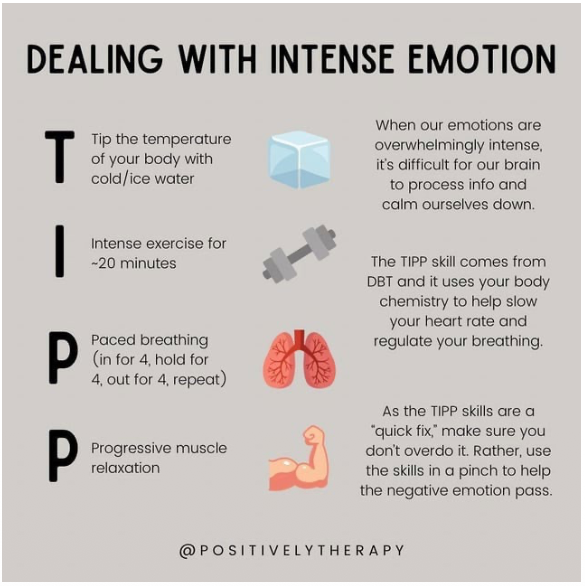 Source: Dr. Becca @positivelytherapy on Instagram
A Note About Diagnosis
While anxiety commonly walks alongside ADHD, ASD, and SLD and all of these diagnoses have many overlapping characteristics, they are distinct diagnoses with differing reasons for the behaviours we may observe. Because of this, we must collaborate with trained professionals who take a detailed history so they can tease out what may be causing challenges for our child and then make appropriate recommendations.
This website provides excellent visuals to explore these differences and similarities: ADHD Infographics | Visual Guides by Neurodivergent Insights
Additional Resources
- Untangling ADHD and Anxiety as Comorbidities – The REACH Institute Anxiety
- CHADD – Improving the lives of people affected by ADHD
Counselling Services & Wraparound Support
We continue to have a counsellor supporting the needs of our learners in Grades K–6. If you would like to have your child connect with her, please reach out to Jenny Duffield.
I am here to support the needs of our Grades 7-12 students. If you would like your child to connect with me, please reach out to me via email.
Lastly, if you have any questions or concerns regarding your child’s learning journey, you can also reach out to our Head of Student Supports, Paige McDonald.