
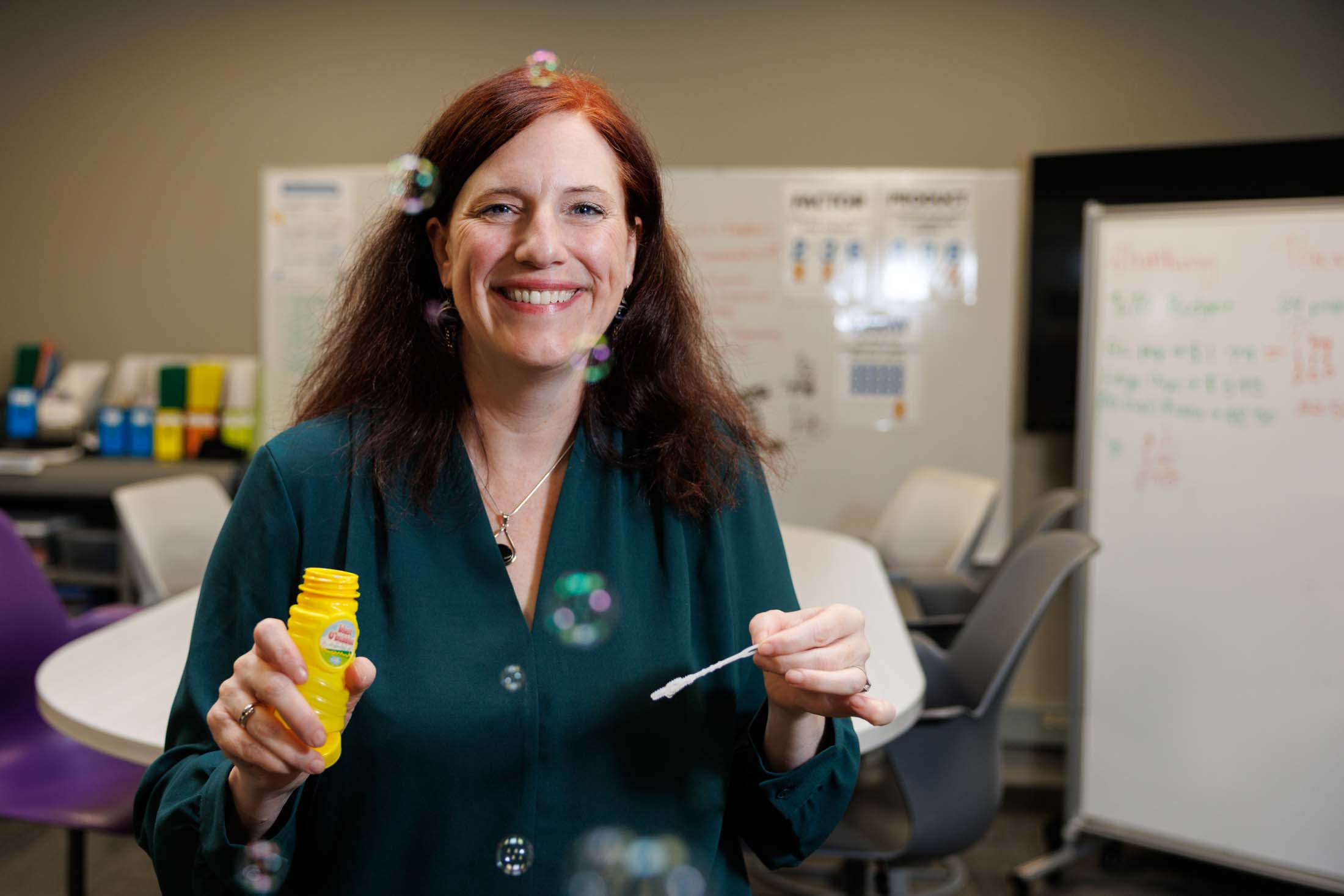
Calgary Academy’s Head of Student Supports, Paige McDonald, has worn many hats during her career. Since becoming a psychologist in 2019, her work has focused on helping students succeed in school and life.
Her curiosity and love of learning have led her far. From the world of executive recruitment to supporting unique learners at CA, Ms. McDonald is in a place where she feels excited to make an impact each day.
Finding Her Passion
With a degree in economics, Ms. McDonald helped build Boards of Directors, finance teams, and other leadership groups for 13 years before becoming a psychologist.
When her daughter began struggling in school, she was surprised. Her child was bright, but her psychoeducational assessment revealed a diagnosis of dyslexia, which explained her difficulty with reading.
Researching as much as she could about learning differences to better understand her daughter’s needs, she kept thinking, “how many people have never had a chance to reach their potential because someone decided they weren’t smart?”
Ms. McDonald decided to learn everything she could about how the brain develops, and eventually earned her master’s in counselling psychology. .
After her convocation, she worked at a school for several years before joining Calgary Academy this past fall. She had always heard about the school and felt excited about a new opportunity.
“I knew that there were some very talented people here, saw the job posting, and it was really interesting… Honestly, I was so impressed by the Strategic Plan that I thought, ‘if they do half of what they say they’re going to do, that’s going to be a pretty exciting place to be.’” – Ms. McDonald
Holistic Support
Ms. McDonald has an inclusive philosophy regarding the school’s student supports. While CA has smaller class sizes and well-structured programs, each learner is unique. What works for some doesn’t work for everyone.
She notes that while support can focus on individual skills in isolation, it’s important to prepare students to work effectively in group dynamics.
“Our teachers are very knowledgeable, so when we’re identifying kids who are in highly supported structures but still need additional support, the idea is to come in and look at how we set them up for success. Often, support is looked at as, ‘pull them out of class and let’s do one-on-one work,’ when really our goal is to build skills for the classroom.”
She sees her colleagues, who include the literacy, numeracy, speech-language pathology, wellness, occupational therapy, and counselling teams, as the “glue” of the school. They help ensure a student’s needs are met across all classes and provide individual support for learners.
With her background in psychology, Ms. McDonald recognizes how all aspects of a child’s life can affect their learning. Daily classes will not solve every struggle, and she understands that schools and families must work together.
“If a student is struggling with seeing themselves as a learner, it doesn’t matter how many foundational skills we put in. We have to look at all the pieces surrounding the student. That, of course, works best when we have parents and guardians coming alongside and working with us.” – Ms. McDonald
Mastering a skill takes time and repetition, and it can become easy to get lost in the expectations of where a child’s learning should be. What matters is finding the support a student needs to begin their growth.
To Ms. McDonald, seeing students overcome challenges after their hard work is the best part of her job.
“Seeing a student where it just clicks, and they’re like, ‘I can read,’ and they surprise themselves. Or the child who’s really struggling with peers, and then you overhear them in the playground using emotional vocabulary and problem-solving and then go off and play. It’s incredible to watch.”