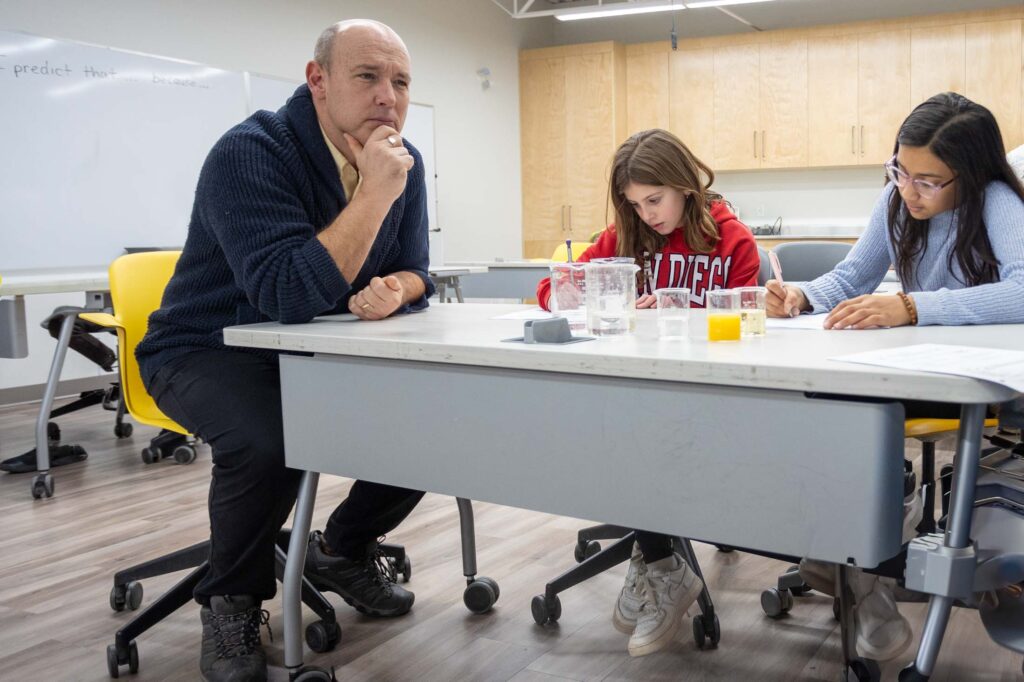
Meet Our People: Dean Carter

Whether it’s dressing up for Halloween, participating in staff events, or helping referee Knights Athletics, Junior School teacher Dean Carter has made an impact in his first four months at Calgary Academy. With a previous career in theatre, he’s not afraid to try new things—like teaching at a new school after 19 years at a previous institution.
Mr. Carter is one of the school’s new faces this fall. With decades of teaching experience, he brings warmth, energy, and a love of storytelling to the classroom.
From the Stage to the Classroom
Before finding his path as a teacher, Mr. Carter spent several years as an actor. He had started his career in education immediately after high school but felt he was too young to teach. He decided to pursue theatre, first in Red Deer and then at a conservatory school in Toronto.
He spent several years touring in different shows throughout Alberta, Ontario, Quebec, and the United States. Mr. Carter sees these years as fundamental to his teaching style—he understands the importance of connecting with your audience.
“You have to find a way to connect… Imagination is one of the best ways to connect with children. I like to use many things in my teaching: theatre, different ways of approaching things, stories, and getting the students out of their desks.” – Mr. Carter
After nearly a decade in theatre, the classroom called Mr. Carter back. During his late 20s, he worked on a show performing Robert Munsch’s stories. He got to work closely with children, which reminded him of why he first wanted to be a teacher. In his opinion, spending time with his students is the best part of being an educator.
“I love building connections with students and seeing them succeed and do something well in class. They’re really proud to show you.”
Bringing His Experience to CA
Mr. Carter worked at his previous school for 19 years before coming to Calgary Academy. While he loved his time there and learned a lot as an educator, he felt it was time for a change. He was interested in working with students requiring unique needs, support, and learning—which led him to Calgary Academy.
 Though in a new school, Mr. Carter has plenty of experience working with students. His teaching philosophy is to ensure everyone feels safe in the classroom. He remembers how his teachers treated him as a child—kind and gentle with a great sense of humour.
“I want students to feel comfortable… My teaching philosophy is to create a classroom where everyone feels welcome, safe, and seen. If the students can do that, the academics will come later.”
Mr. Carter works closely with his partner teacher, Ms. Powell, in the Academy program. It’s the first time he has team-taught before—one of many new experiences at CA.
Technology is more utilized than at his previous school, and he has never had the support of a Learning Team before. He has the encouragement of his fellow teachers to thank for his positive experiences thus far.
As Mr. Carter continues his first year teaching at Calgary Academy, he believes he’s only seen the “tip of the iceberg” of what the school can offer. He looks forward to seeing his teaching progress, making more connections, and, most importantly, seeing his students improve and learn.
“I’m excited to see how these kids grow in the class and how I continue to adapt to the curriculum. I’m also really excited to get to know people even more.” – Mr. Carter
CA Chess Club: Community, Collaboration, and Challenge
On Thursdays during lunch, a certain classroom in the Grade 9–10 hallway is full of energetic students strategizing their next chess move, chatting amongst each other, and hopping between boards to see the progress of each match. The CA Chess Club has become a popular spot to spend the lunch hour every week.
The recent love for chess at Calgary Academy isn’t a coincidence—people have played the game for centuries. What seems like a simple match is a battle of wits and strategy to get the endpoint: checkmate.
CA Senior School teacher Justin Park has helped establish excitement through the school’s Chess Club, providing a safe space to learn, challenge oneself, and collaborate.
A Love of Chess
Mr. Park has played chess since he was four years old. He jokes that if someone sees him outside the classroom on his phone, he’s either on Instagram or playing online chess. Mr. Park sees it as a timeless yet limitless game—there’s always something new to learn.
“People have been playing chess since medieval times, which shows how straightforward it is… The rules are predictable, but there are so many combinations and different strategies. It’s just endless.” – Mr. Park
Mr. Park first developed an interest in hosting a chess club in his teaching practicum, where he brought in chess boards to let students casually play and learn the game.
At the beginning of the year, Mr. Park checked if there were plans for a club (there weren’t) and then gathered as many chess boards as possible, eventually purchasing more due to the club’s success. Chess is slowly taking over the school, with a Junior School club recently starting on Mondays and Wednesdays.
Besides hoping to bring his passion for chess to CA, Mr. Park knew that school clubs could lead to unlikely connections between students.
“I saw the success of chess during my two practicums, and I thought if there’s no club at CA, why not? I believe it’s a healthy way for students to connect, learn skills, and have fun. I wanted to bring my previous passions and experiences to the school.”
Chess teaches many lessons students can apply to school and the rest of their lives. Mr. Park regularly sees learners using problem-solving, geometry, critical thinking, concentration, and collaboration. Students will help each other make moves and see angles others may not notice.
A Safe Space to Play, Learn, and Connect
Chess Club runs every Thursday at the school during lunch. Students bring their food, grab a chess board, and pair up to play.
 If students just want to watch, they’re more than welcome to—though Mr. Park likes to try and encourage everyone to sit down for a game, even if they’re a beginner. He’s happy to teach anyone how to play, but don’t expect him to go easy once the match starts.
One CA student, Lincoln M., has enjoyed the popularity of Chess Club, playing against other students every week. He hoped to have a few games throughout the year but was surprised by how many students were interested in chess.
“I first thought that Chess Club would be an okay year where we would have a few people here and there, but the fact that we manage to have five games going at once now is amazing.”
Chess can seem daunting, but Mr. Park and Lincoln believe choosing to play chess is the hardest step to take.
Winning games isn’t the goal—the fun is in improving skills every week. Lincoln encourages anyone interested in chess to find a board and get started.
“My main advice is to just play. Try and think about what your opponent will do and try to counter that, but overall, learn and play.” – Lincoln
Chess Club shows the importance of extracurriculars—they help foster connection, passion, and learning outside of the classroom. Mr. Park has loved seeing students become interested in chess, hoping everyone can find what inspires them, no matter their interests.
“I feel students should always follow their interests regardless of what others think because it could be their next new thing… I encourage students to look for opportunities everywhere.”
Chess Club runs every Thursday at lunch, so bring some snacks and stop by to learn, play, or watch.
Jane McCaig: A History of Scholarship
Recognition celebrations at Calgary Academy are a special affair. While each may look different based on a grade’s specific teachers, students, and respective interests, what they all share is a commitment to ensuring every student leaves knowing their accomplishments are worth celebrating.
One longstanding legacy at CA is the Jane McCaig Award. The award’s objective is to encourage students to continue learning, awarded to a student in Grades 9–11. Recognizing an all-around student who has exhibited significant improvement, is enjoying school, and serving as a role model to others, the Jane McCaig Award has been presented without interruption for 28 years.
The award is named after its founder, alumni Jane McCaig (’88), who was a student at Calgary Academy during its first year of operation. Jane established the award at the age of 25, wanting to give back to the school that had helped her succeed.
“I had no idea, no clue that it was going to last for 30 years and become so popular with students.” – Jane
In the nearly 30 years since she established the award, Jane has been back in CA many times. Before having kids, she served on the scholarship panel, eventually stepping back to let CA administer it independently. She then returned as a proud aunt, as her nephew and niece attended the school.
Life came full circle when Jane enrolled her son, Anthony, at Calgary Academy in Grade 7. From that point on, she was re-engaged as an active member of the school community, volunteering on the 40th Anniversary Committees, right up until her son graduated from Calgary Academy in 2022.
“I don’t know if I’ve talked with my kids about our legacy,” Jane reflects. “But mine was always going to be Calgary Academy. The school has been such a huge part of my life, and I know there are so many students out there who learn differently, like me.”
Now, as both an alumni and an alumni parent, Jane is getting more involved in the award administration again.
“My daughter is about to turn 25—the age I was when I established the award, and she’s also decided to support a scholarship for young students. Hopefully, one day, my kids will have their own legacies.”
The McCaig family was showcased as part of Calgary Academy’s 40th Anniversary celebrations. To hear more about the story, watch the video below.
Conversation and Culture: Life in CA’s Spanish Program
Just past Calgary Academy’s Black Box Theatre lies the Spanish room. Student projects hang around the door, and inside, the classroom walls are filled with various posters, projects, flags, and other Spanish-themed decorations. The room is comforting, creating a captivating space to learn in.
Integrated Studies teacher Jessica Fonseca understands that learning a second language is more than reading verbs off a whiteboard—combining conversation, culture, and her unique experiences into daily classroom teaching.
Language is Culture
Learning a second language is one of the most applicable skills students can develop, especially from a young age. To Ms. Fonseca, learning Spanish (or another language) can help someone not only navigate the world around them—Spanish is the fourth most spoken language worldwide—it can also help students work in a world that’s becoming more internationally connected than ever.
“Many people have travelling in common, and you will likely encounter a language situation. I tell my students, ‘if you’re in the middle of Madrid and trying to get around, what’s the first thing you do?’ Language is like a survival skill.”
 Described as a “jam-packed hour of learning,” Ms. Fonseca’s classes focus on conversation and culture. While learning the building blocks of a language is important, so is immersing oneself within the culture—real-life experiences matter just as much as the classroom.
Ms. Fonseca utilizes Rosetta Stone as part of her curriculum to help students study at their current level while focusing class time on conversation-focused learning, off-campus trips, and cultural activities, like creating ofrendas for Día de los Muertos. To her, “learning language is opening the perspective of learning culture.”
Long-time Spanish student Sheyna C. finds that her classes offer unique experiences that can also prepare her for life after school. She remembers visiting a local market to converse fluently with Spanish speakers.
“Spanish prepares you if you want to do something with language in the future. If you get stuck in a country, you don’t need to know how to conjugate a verb… It prepares you for real-life experiences, like travelling, restaurants, and stores.” – Sheyna
Another essential element of Ms. Fonseca’s Spanish class is the use of her own experiences in life. Understanding that learning a new language can be difficult or even embarrassing for some students, she acts as a storyteller, recalling moments when she made her own errors.
Ms. Fonseca remembers travelling to Bali, attempting to speak the language with the locals and saying a phrase wrong. However, this “mistake” helped her connect with others, learn more about the language, and respect the culture she was in at the time. She’ll help her students feel comfortable in class making language mistakes—typically leading by example.
“Sometimes, I make a fool of myself in front of the students so that they can relax. We don’t laugh at each other—we laugh with each other.”
The Future of Language for CA Students
Language opens a world of opportunities for CA students, whether it’s learning other languages or benefitting their studies. Spanish is closely related to Portuguese, French, and Italian, making them easier to learn in the future. For students like Sheyna, Spanish grades can help with university applications or navigating the world when travelling.
“I love how students by the end of the program feel a sense of accomplishment when they can understand and self-express in a second language… I love seeing them happy and able to express themselves.” – Ms. Fonseca
While her Spanish class offers unique opportunities, Ms. Fonseca understands that not every student is interested in learning that subject. To help bring a wide variety of learning options to the school, she has helped bring a new pilot program Integrated Studies course to life at CA starting next semester for Senior School students: International Languages.
This course brings the ideas taught in Ms. Fonseca’s Spanish class to other languages, including French, Italian, German, Mandarin, and Japanese. Rosetta Stone-based learning and cultural immersion will help students learn a new language and gain an appreciation for other cultures.
While Ms. Fonseca can teach as much as she can during class, she knows that the real challenge is up to students when they leave CA. She hopes graduating students want to build upon their Spanish foundations.
“The truth is, learning a second language, it’s all exposure. You must embed it in your life every single day. I always tell my students that here in school, I’m going to give you 40%. Unless you put this language in your life, it’s hard to be completely fluent.”
Dig Pink: 15 Years of Community
Whether someone is a volleyball fanatic, a supporter of the cause, or just loves the colour, Dig Pink is an iconic part of every school year. This year is the biggest event yet—with 30 participating teams, Calgary Academy is looking to add to the $160,000 raised since the inaugural tournament.
A few days away from the 15th anniversary of Dig Pink, let’s take a trip down memory lane. The tournament’s humble and altruistic beginnings continue to impact the CA community.
Bringing a School Together
Dig Pink started as a simple idea: “why don’t we host a volleyball tournament and raise some money and awareness for breast cancer research?” This idea has had an incredible ripple effect no one could have predicted at the first tournament.
Senior School teacher Mark Schuegraf remembers the first Dig Pink well. While the tournament experienced a significant problem, the response from visiting schools showed the power of the community.
As Dig Pink was just getting started, an electrical outage cut power to the school, gyms, and surrounding neighbourhood. After sitting in a Starbucks (one of the only nearby buildings with electricity) for over an hour, CA staff knew they had to cancel the tournament.
With heavy hearts, teachers contacted all the teams to refund their entry fees, but something special happened when they reached out: everybody refused.
“We emailed every team apologizing and offered a refund, and every team without fail said, ‘keep the money, donate it to breast cancer research, and just have us back next year.’” – Mr. Schuegraf
Dig Pink is bigger than ever now, but its heart has never changed. It’s an event that connects the CA community every year, with everyone pitching in to help as scorekeepers, referees, and fundraisers.
Almost too many people want to help every year—whether it’s staff, students, parents, or alumni returning to CA. The community working together helps keep costs as low as possible so all the incoming funds can go to the Alberta Cancer Foundation, from cupcake sales to team entry fees.
 In the school, the hallways fill with supportive signs and messages, pink t-shirts, and the smell of fresh baked goods. Students cheer as loud as possible during games, and many teachers have dyed their hair, beards, and moustaches pink.
Each tournament begins with a pep rally and opening game, with the Senior girls repping homemade jerseys. The stands fill with students from all grades, creating a wave of bright pink outfits. Everyone can feel the electricity when they step into the gym.
For students, many athletes grow up wanting to represent their school and community years before they join the volleyball team.
Senior girls volleyball player Madi Y. remembers watching the tournament when she was younger and looking forward to when she got to step onto the court.
“I remember when I was in Grade 5 and seeing how big this tournament is. Being able to play in it now is amazing. I think it’s the best part of Dig Pink.”
Whether it’s excitement to play in the tournament, raise donations, or show school spirit, everyone comes together to celebrate. On the surface, Dig Pink is just a volleyball tournament, but its impact runs much deeper than sports—it provides a safe space for everyone to speak about the impact cancer has had in their lives.
The opening pep rally typically includes an inspiring guest speaker, whether it’s a teacher, student, parent, or representative from the Alberta Cancer Foundation. When reflecting on Dig Pink, Mr. Schuegraf believes it drives all participants to want to better themselves.
“Dig Pink touches so many lives that you don’t even know about… I think it gives everybody that sense of purpose and drive to want to be better and do something positive.
Dig Pink is bigger than volleyball. It’s bigger than any of us. It’s something more.” – Mr. Schuegraf
Come Celebrate 15 Years of CA Pride
A few days away from the first serve of this year’s tournament, players, coaches, students, and staff are all waiting to throw on their pink gear and get started.
Two Senior volleyball players, Noor M. and Sydney L., see Dig Pink as a highlight of the school year. The tournament is a favourite memory for many students’ times at CA.
“Making friendships and playing with your teammates is the best. It’s really fun to have games that are so exciting.” – Noor and Sydney
While CA’s Head of Athletics, Nick Waterbury promises another year of significant fundraising and volleyball thrills, he most looks forward to seeing everyone come together, no matter what school they’re from.
“When I go to other schools who have been in the tournament before—they wear Dig Pink stuff instead of their school hoodies… It’s cool to see how the entire community comes together. We’re not just CA—we’re all here for Dig Pink.”
Join the CA community to catch the volleyball action from Oct. 19–21. Celebrate another year of Dig Pink and support an important cause by donating to the Alberta Cancer Foundation.
Meet Our People: Sheryl Walters
A new nameplate is visible when walking down the Senior School hallway, Assistant Principal Sheryl Walters. While new to this particular role, Ms. Walters has been an ever-positive presence at Calgary Academy for years.
From Junior School teacher to Learning Team Design Lead, Ms. Walters brings a wealth of knowledge, experience, and passion to the School Administration team. She manages CA’s Senior School, planning teacher schedules, responding to student, parent, or teacher concerns, and handling the inevitable issues that can arise in a school.
A Decade at Calgary Academy
The career transition from educator to administrator is a big one, but Ms. Walters is no stranger to a challenge—she started her master’s degree in her first year of teaching.
Teaching at CA since graduating from university, she enjoyed several years in the classroom while learning outside of it. The master’s degree opportunity included three years of working with mathematics teachers across the school, reflecting on how they could be the best educators possible. Ms. Walters sees this experience as being foundational to establishing who she is as an educator.
“I think the master’s degree set me up for success because I had to be heavily reflective from my first year. I constantly thought about my teaching practices, reflected on them, shared them with others, talked about how I could improve… I can’t imagine a better start to my career.” – Ms. Walters
After several years in the classroom, Ms. Walters joined the Learning Team, a group of educators who support classrooms in every grade. Besides working with teachers daily, Ms. Walters saw the opportunity as a way to improve learning throughout the entire school.
“As I shifted into the Learning Team, it was an exciting opportunity to take what I enjoy doing in my classroom and work with new staff and other teachers to implement those practices… I took what I did in the classroom and applied those ideas on a larger scale.”
Assistant Principal Walters
While Ms. Walters brings plenty of experience to her new role, there are still challenges someone can’t anticipate. A principal has a bird’s eye view of the school, seeing how all the pieces come together.
Ms. Walters’ days revolve around all Senior School classes, not just a single classroom like when she was a teacher. She has had to flex her planning muscles, but even if someone plans their entire week—things can shift in a day. She sees flexibility as one of the most essential skills for a principal.
“I think I have learned to be flexible working here… You shift things to meet the needs of the learners. Some of my other responsibilities have to change if there’s a student or parent concern.”
A month into the school year, Ms. Walters easily handles everyday life as a principal. However, her role is much more than daily scheduling and planning. Student success is always her top priority—inside and outside the classroom.
“When students leave here, I want them to feel they understand themselves and know they can pursue their interests and utilize their skill set to find success in whatever they choose.”
While school can feel like the entire world for students at times, it’s only the beginning of their journey. Ms. Walters hopes all CA students graduate with a deeper understanding of themselves. We’re all learners—no matter the path someone takes.
“It’s important that students graduate feeling good about themselves as a person and learner, knowing they can contribute in meaningful ways. The future doesn’t need to look the same for each person.” – Ms. Walters
As Ms. Walters continues her first year as an assistant principal, she’s excited to reflect on how she’s changed within her new role and find ways to improve the school experience for all teachers, parents, and most importantly, students.
Braydon McAndrew: Following Your Own Path
It’s been five years since Braydon McAndrew (‘18) walked across the stage at Calgary Academy, diploma in hand.
His life has taken a drastic turn since then, with Braydon moving on from his job as a gymnastics coach towards a future in social media content creation.
Finding a TikTok Audience
A self-proclaimed “unfocused student,” Braydon wondered what life after graduation would look like. He didn’t see himself attending university in the future—he was interested in entrepreneurship.
One day in his final year of school, Braydon attended a lecture held by a guest speaker at CA. The speaker detailed their current career, car detailing, and how they worked independently. The speaker made money doing something they loved.
While other students enjoyed the lecture (or goofed off with friends), Braydon was engrossed—quickly pulling out his phone to take notes. To Braydon, this speaker opened his eyes to future possibilities.
“When those motivational speakers came in, I took notes because I was interested in business. That’s one thing about Calgary Academy that inspired me.” – Braydon
Braydon worked as a gymnastics coach full-time after graduation, teaching and supporting kids of all ages. When COVID-19 spread throughout Canada, he found himself without a job and with a lot of time on his hands. With his passion for social media, Braydon began posting videos on TikTok.
 One of his videos (ironically discussing “three ways to blow up on TikTok”) eventually hit over 500,000 views. His storytelling videos continued to reel in viewers—he has now reached billions of views across various profiles. Looking back, Braydon describes this experience as addicting—driving him to work harder.
“You gain a bunch of followers, tons of comments, and then you just think: ‘how do I do this again?’ Instead of just hitting 500,000 views, how do I hit 5,000,000?”
While the views validated the work Braydon had completed thus far, he wanted to start a career. In the social media game, followers don’t always equal profit. While posting doesn’t bring in a steady income, creating a partnership can.
After receiving several offers to help promote an app, Braydon decided to try it out.
“I eventually did one ad promotion for a game. In 24 hours, I made a good amount of money. It was around half my yearly salary as a gymnastics coach from one video.”
Taking the Next Step Forward
While he enjoyed being in front of the camera, Braydon realized he could have a future working behind it. With help from his business partner, Braydon is connecting with and supporting other content creators.
Whether it’s setting up Snapchat shows or partnering with creators, Braydon and his team are helping creators shine. When working with content creators, they receive approximately 50% of the total revenue from videos.
“We do deals where we get a percentage of their YouTube channels and other income streams… We help them grow and make money. It’s a win-win for both parties.”
Braydon is happy with his current success but looks forward to building his career. He believes confidence is essential for anyone pursuing their dream—whether someone just graduated school or is looking for a career change.
“If you have a dream, don’t let people hold you back… Don’t give up, because lots of people do when they come across one roadblock. If you keep pushing through, you’ll find success.” – Braydon
With Braydon’s work ethic, he’s confident he’ll reach his goal in the future—selling a successful social media company.
Conquering Juan de Fuca: Wilderness Becomes the Classroom
What is three words, 48km long, and features rugged terrain, unpredictable conditions, and breathtaking scenery? Juan de Fuca Trail, of course! Located along the coast of Vancouver Island, it is one of the most well-known hikes in the west and our students set out to find out why.
Outdoor Education (OE) is one of the most beloved option courses at CA, and its popularity is well-deserved. The program fosters friendships through collaborative problem-solving, peer support, and shared outdoor expeditions.
Last April, a tight-knit group of 11 Senior School students eagerly strapped on their backpacks, laced up their hiking boots, and hit the Juan de Fuca trail—a demanding coastal adventure that lead OE instructor, Jason Lindsay, describes as “no joke.”
“OE is based on learning skills and then applying those skills. You can’t do that without trips, including overnight trips. On longer trips, the dynamics change, the students change, and that’s what I was seeking.” – Mr. Lindsay
The idea came to him in December and just three weeks later, his OE class was given the green light to begin preparing for their year-end expedition, just mere months away.
With 11 previous Juan de Fuca treks under his belt, Mr. Lindsay understands that even seasoned hikers encounter new challenges on this trail, highlighting the importance of preparation and proper nutrition.
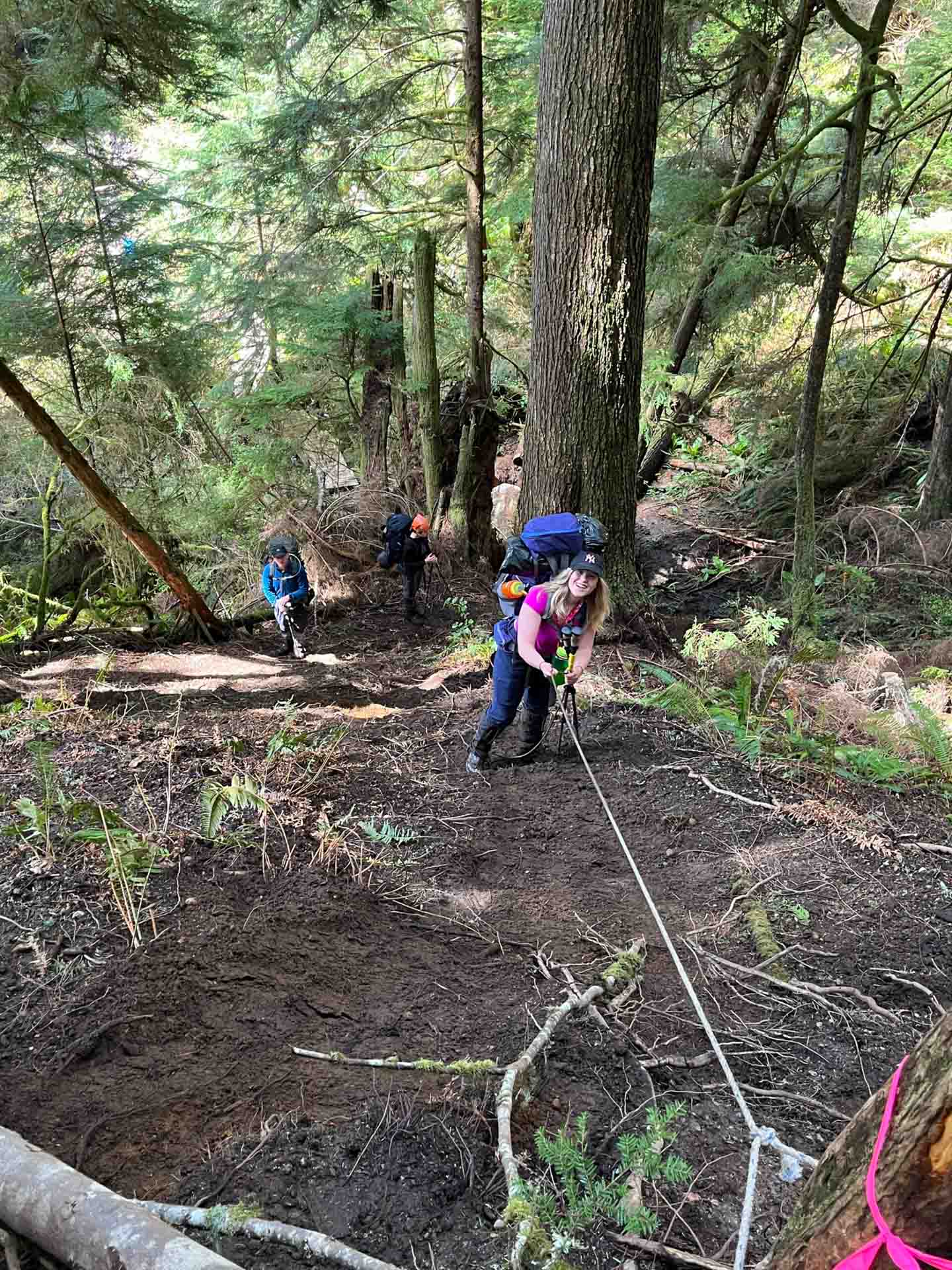 Packing the correct food supplies is crucial for outdoor excursions, and the OE students excelled at efficiently using it as fuel. This was evident in their cooking challenge this past April where they were put to the test in creating well-balanced and portable meals.
This ensured they were equipped long before their journey began, aligning with Mr. Lindsay’s objective to “show them how to thrive in the wilderness, not just survive.”
To begin their trip, students departed Calgary to Victoria by plane and boarded the West Coast Trail Express bus. After being provided with fuel and bear spray, they began their excursion through lush forests and tall trees.
Students learned that ever-changing terrain, including river crossings, waterfalls, and rocky beaches, to quick weather changes, only to be met moments later with expansive ocean views and bountiful wildlife, are what make Juan de Fuca an awe-inspiring adventure every step of the way.
The second day proved the most strenuous as it featured the trail’s highest elevation gain. Each subsequent day, students overcame adverse weather conditions, wet and muddy forest floors, a missing storm shelter, and a bridge that had been knocked down by a tree.
Unexpected conditions aside, it was in the moments of calm that students came to appreciate the vastness and serenity of nature and reflect on how hard they had pushed themselves thus far. Students eyed lots of wildlife, including bald eagles, seals, sea lions, and hummingbirds.
Following one of their most exhausting days, students concluded it with a relaxing campfire on the beach to appreciate the vastness of nature, share laughs and stories, and create stronger support systems that would carry them through the rest of their journey home.
“I’m incredibly proud of the students. They’ve been a really great group and I look forward to reconnecting with each one as they continue in nature and grow into their own version of an explorer.”
As their trip came to an end, Mr. Lindsey reflected on many epiphanies that emerged, with one standing out among the rest. One of the biggest lessons on the trip was to break down any challenge into small, manageable steps. This is something that can be applied in anyone’s life, but for students to be able to learn this at a young age when they are on the cusp of graduating is one of the biggest hopes for Mr. Lindsay’s students.
“Being able to say, ‘I can persevere, I am resilient, I am capable, I can trust other people to help me along the way, and I’ve got a whole bunch of friends now because we did this together,’ this is one of the strongest epiphanies that came out of this trip.” – Mr. Lindsay
Students in Grades 9–12 can become students of nature with OE by gaining skills in self-discovery, adventure, and resilience. There are many more exciting opportunities planned for the 2023–24 school year. Find out more about Integrated Studies here.
CA Cross-Country: Running Through Adversity
Blink, and you’ll miss it—Calgary Academy’s cross-country season is quick, starting and finishing within the first few months of the school year.
Students work hard between early morning practices and the final cross-country race, learning many lessons throughout the season. When running (or life) becomes tough, a strong mind can help you overcome anything.
Individual Runners, Team-Based Sport
The origins of cross-country date back hundreds of years, with runners moving through open fields, trees, and hills as far back as the 1800s. While the sport has evolved with time, its heart has stayed the same.
Cross-country is a staple of school athletics—filling a niche for students seeking a challenge. The special qualities of the sport inspire CA teacher Jason Lindsay—the head coach for CA’s cross-country athletes.
Mr. Lindsay feels the sport challenges students in a different way. Athletes aren’t just running around a track—they navigate uneven terrain and potential obstacles.
“Athletes are on paths, grass fields, or golf courses. They’re in the school forest and going up and down hills. Sometimes, they jump over a fence or go through a river. Cross-country races have unpredictable elements, and that differentiates it from other sports.” – Mr. Lindsay
Something spectators may not know is that cross-country is a team sport. While student-athletes run individually, they score points as a team. Each runner’s placement adds to an overall team score.
Runners don’t need to worry about being first or last. They have their teammates with them—cheering each other on and waiting at the finish line for a well-deserved rest.
“Cross-country is a team-based, individual sport, and students can rely on the fact they have their teammates. While students run independently, they have people around supporting and encouraging them.”
Becoming Comfortable Being Uncomfortable
All sports teach lessons, but none are quite as unique as cross-country. Besides instilling a love of fitness, cross-country teaches athletes the value of discipline and hard work.
The shortness of the season means that students prepare for a single run compared to the multiple games and tournaments in a volleyball or basketball season. Early morning practices, balancing nutrition, and mental preparation are essential as runners train for their race—something CA teacher and cross-country coach Neil Frail reinforces with his students.
“This might be the first time some students have had to do something like this—prioritizing their nutrition and exercise over a short period of time.
Early morning runs three days a week are not easy. Our students are setting a goal for themselves and sticking to it.” – Mr. Frail
A bit of an Ironman himself, Mr. Frail sees the cross-country season as a test of mental resilience. No matter how trained a runner is, they will become tired, but staying focused on the finish line will help them reach their goal.
 “Some students are running up to six-kilometre races… that’s a long time to spend in your own head, especially if you’re physically tired. I think cross-country teaches students to be comfortable with being uncomfortable. It’s such a valuable skill that transfers to other places in life.”
One CA student, Brianna R., has learned many lessons this cross-country season. Seven a.m. practices have paid off, with her finishing tenth in her age bracket at the season’s cross-country race.
During the race, Brianna’s eyes focused on the heels of other runners as she paced herself through CA’s surrounding forest, waiting for the perfect moment to pass and move up a position. Her day concluded with a full sprint to the finish line, cutting through the sound of a cheering audience.
Brianna understands the importance of focus during a race—keeping herself motivated through self-encouragement.
“I just tell myself, ‘you’re almost there, and you got this.’ I encourage myself to keep going. If I have a cramp or something, I’ll jog slower and take deep breaths to breathe through it.” – Brianna
No matter what place a student finishes their race, they leave with an important message. Everyone becomes uncomfortable at some point, whether it’s in school, work, sports, or life. What’s important is to keep moving forward, one step at a time.
While students ran across the finish line after two days of racing at the school, they have more kilometres to run. League and zone championships will occur in the next few weeks, with the potential to compete provincially at the end of October.
June Exemplary Practice & Student Showcase Recipients
The Exemplary Practice and Student Showcase awards happen twice a year in February and June, shining a light on exceptional members of the Calgary Academy community. These awards recognize the contributions of staff and students demonstrating excellence, leadership, and innovation to support HLG in achieving its mission and advancing overall effectiveness.
This year’s June awards recipients include:
- Ms. Christine Talukdar
- Addison H., Grade 10
Christine Talkudar
The recipient of the Board’s Exemplary Practice Award for June 2023 is Creative & Web Lead Christine Talukdar. Christine is described as an innovative, highly knowledgeable leader.
 Her exemplary creative design skills have elevated every visual aspect of HLG—from publications and advertisements to websites, landing pages, and custom apps. Christine made her mark and elevated the brand profile of HLG.
Christine joined the HLG community in April of 2018. She graduated from George Brown College, bringing extensive industry graphic and web design experience to her role at CA.
Her creative visual fingerprints are everywhere, including nine sub-brands within Calgary Academy, multiple websites, countless SharePoint sites and applications, on the walls and busses of CA, and in virtually all print materials, including for admissions material, drama productions, graduation ceremonies, recognition nights, Strategic Plans, the Annual Education Results Report, Captivate Annual Impact Report, and much, much more!
Addison H.
The recipient of the Board’s Student Showcase Award for June 2023 is a Grade 10 Blended+ student, Addison H.. Addison has been at Calgary Academy since early elementary and transitioned to the Blended+ community in its inaugural year last year.
 The nomination for this award was written by her photography teacher, who has seen the work Addison has created for our community.
As a Grade 10 Blended+ student, Addison has excellent time management skills. When she isn’t working on assignments or studying for an exam, Addison keeps herself busy refining her photography skills and reflecting on ways to improve her technique.
She even encourages her friends to capture photos at various sporting events or celebrations. Most recently, Addison made sure to bring a camera to the Blended+ Montreal trip to practice with DSLR cameras and take photos for the yearbook.
Congratulations to these deserving individuals on their achievements and future success at Calgary Academy!