Meet Our People: Caitlyn Gibson

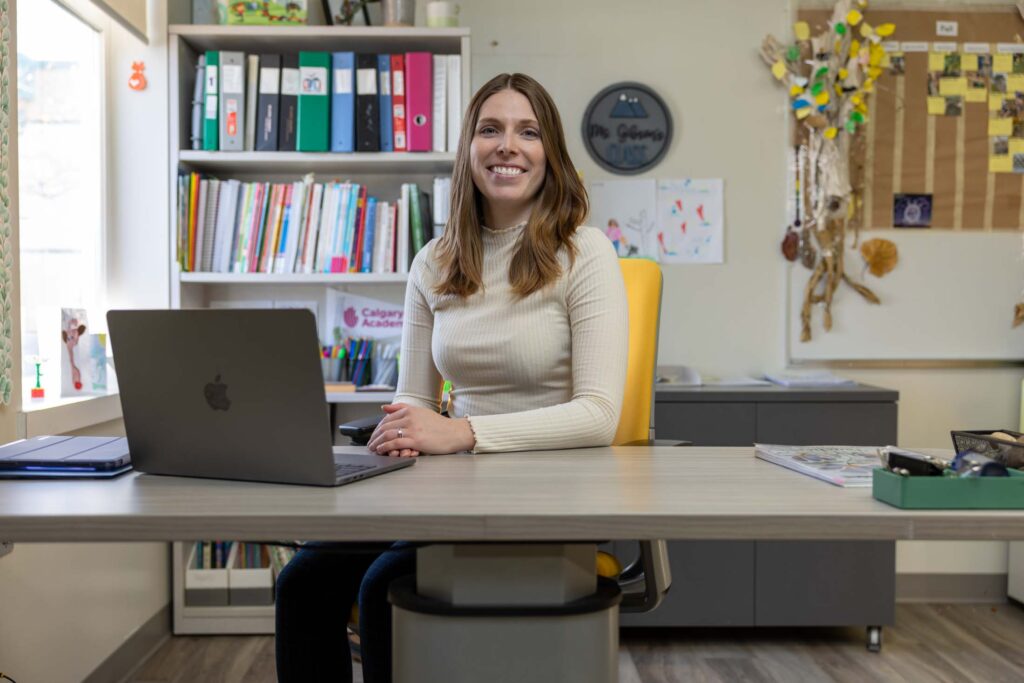
Caitlyn Gibson (’12) has spent many years at Calgary Academy as both a student and a teacher. If you journey down to her classroom, you’ll find a safe, inviting space that reflects her love for the outdoors.
On Ms. Gibson’s classroom wall is a phenological calendar (also called a nature calendar), a long brown sheet of kraft paper covered with leaves, sticks, bark, and photos of other nature findings.
Her students identify physical changes to the land throughout the seasons and animal and plant evidence (flowers, fungi, etc.) to add throughout the school year. It’s a portfolio of the class’s learning as they explore the world around them.
As an Early Years teacher, Ms. Gibson uses the school’s surrounding nature and forest to teach her students engaging lessons while connecting with the natural world.
Learning at CA
Ms. Gibson attended Calgary Academy from Grades 2–12, graduating in 2012. While she is a teacher now, Ms. Gibson originally wanted to be a nurse. However, after some time in university, she realized that nursing wasn’t her ideal career, so she switched to education.
Ms. Gibson remembers reflecting on her time as a student throughout her education degree, where she was reminded about how special CA was to her as a student.
“My education degree was when I reflected on all the things I learned, and then I saw that CA is where I want to be. I never would have thought, you know, at 18 years old, that I wanted to come back.” – Ms. Gibson
She developed a passion for providing students with the support they need throughout her degree. This value was one instilled during her Calgary Academy days.
Ms. Gibson recalls how lucky she felt each year to have dedicated teachers at Calgary Academy. When she graduated from university, she wanted to be just as impactful for her students.
“I had this passion for inclusive learning spaces and honouring that everybody is different and needs different things… I thought about how I felt in such a community-centred space and wanted to be that teacher for the students that entered my doors.”
Teaching at CA
Ms. Gibson teaches in the Early Years program, which is for Kindergarten to Grade 2 students.
Play-based learning is a major focus for Early Years program teachers like Ms. Gibson, who finds it one of the best ways to engage her students. It allows children to learn through play, connecting their actions to the world around them. It encourages curiosity while building important skills like problem-solving and teamwork.
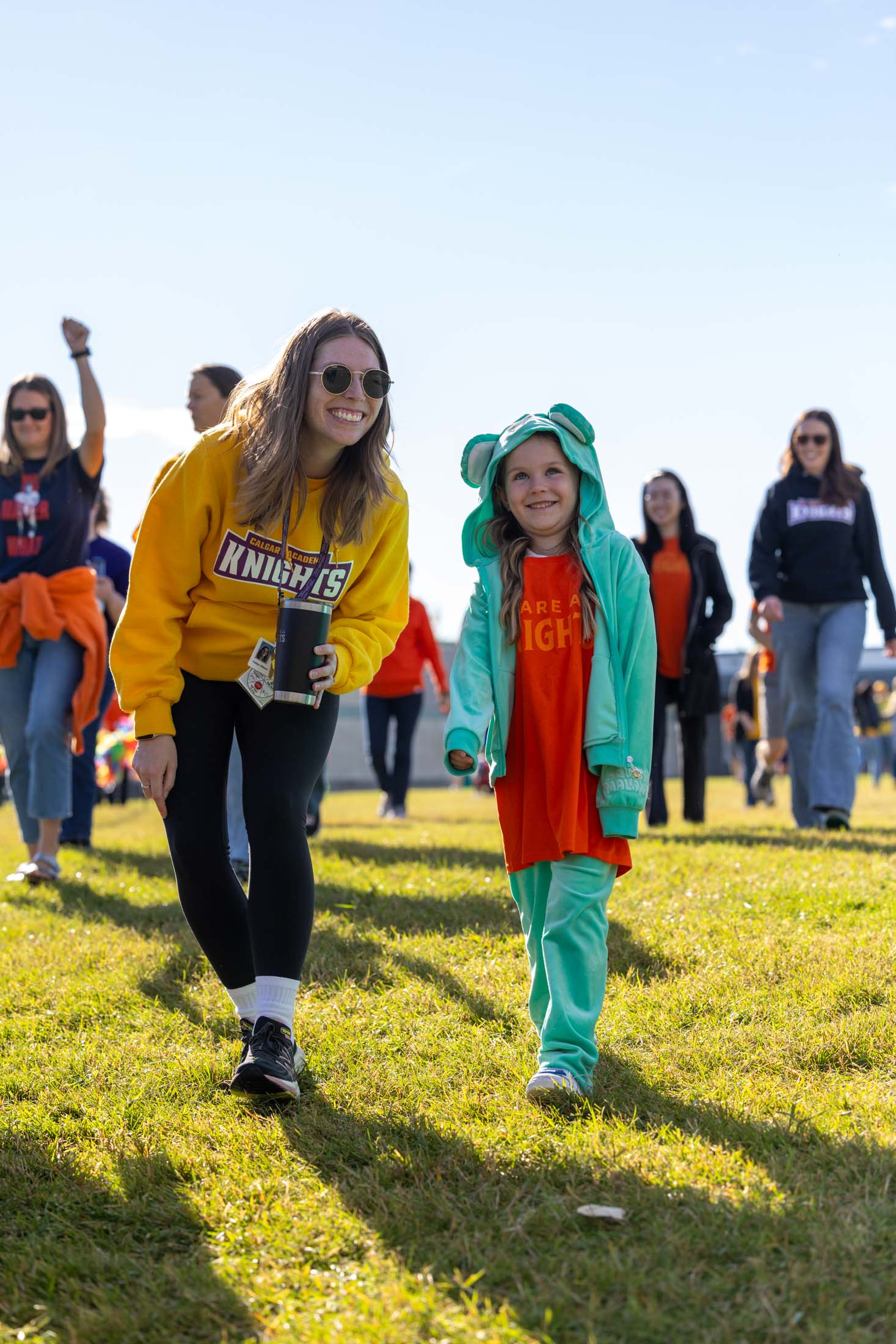 “Any time education can be hands-on, play-based outside, it’s authentic, engaging, learning that I find works well.”
Ms. Gibson currently teaches Grade 1, where she finds as many opportunities as possible to teach her students outside. The forest complements the Grade 1 curriculum, especially science and social studies, where students can learn about the natural communities and the relationships between plants and animals.
Whenever the class heads outside, it has a goal. Some days, Ms. Gibson will give her students a challenge related to their daily lessons, while other days, the students may lead the exploration of the forest to make their own connections.
“You have more structured lessons and student-directed classes, like asking what signs of animals you can find. So, there’s student-guided exploration and then more teacher-guided. There might be a read-aloud and then a task to do. My favourite thing is when the students lead. They have a question, they have a task, but they are the ones that create the wonder and curiosity while naturally exploring.”
Halfway through the school year, Ms. Gibson looks forward to more days in nature with her students and finding interesting ways to make her lessons as hands-on as possible.
Come June, her class’s nature wall will be complete—an artifact of another year of curiosity, learning, and connection with the natural world.
Sundus Mirza: A Future in Medicine
Life after graduating from high school can take students anywhere in the world, like Tbilisi, the capital city of Georgia. This 1,500-year-old city features stunning old buildings, steep cliffs and hills, the Tbilisi Sea (an artificial lake), and a centuries-old botanical garden.
Sundus Mirza (’20), a Calgary Academy alum, lives at this crossroads between Europe and Asia. She has spent several years living in Georgia, studying to become a doctor while living with her siblings.
Now in her final years of medical school, Sundus reflects on her past, navigates her remaining studies, and looks forward to a future as a family doctor, following in her father’s footsteps.
A Short Stay at CA
Sundus attended Calgary Academy for two years—most of it spent online due to COVID-19. Graduating in 2020, she experienced the school’s only parking lot graduation.
Despite social distancing, her favourite thing about her time at CA was the community. She notes that she met “absolutely amazing” people, remembering time spent bonding between online classes and planning for graduation.
Sundus appreciates the support Calgary Academy provides. She remembers her teachers, Mr. Noel, Ms. Holwell, and Ms. Parks-Gierl, consistently cheering her on as she applied for medical school.
“The overall support system encouraged us to be more confident in ourselves and just believe that we could do it… Calgary Academy has been a huge part of my life for that.” – Sundus
With involvement in the grad committee, helping plan the 2020 yearbook, and winning the James E. Chaput Award for Outstanding Personal Qualities, Sundus made the most of her time at CA despite the restrictions placed by the pandemic.
After graduating, Sundus set her sights on becoming a doctor. However, she first had to pack her bags and move from Calgary to the Georgian capital.
Studying in Georgia
Sundus has lived in Tbilisi for the past few years, attending medical school to become a doctor. As a British Canadian citizen, she had many options for places to study. Her university in Georgia, like those in Europe and Asia, offers a five-to-six-year degree that attracts many aspiring doctors.
She remembers stepping off the plane after landing in Georgia, a brand-new place to call home, and thinking, “I really did this.” Sundus remembers having the option to take the majority of her classes online due to COVID-19, but she decided to dive fully into a new culture and country.
“Online classes were an option that ran through my head a couple of times. But then I was like, ‘I’m here. I’ve made that first step. I think I should just keep going.’” – Sundus
Sundus has continued to experience life in a new country, adapting to Georgia’s slower pace and culture, which is different from Canada’s. She spends her days between her studies, shadowing doctors at the hospital, and exploring the country with her siblings.
With medical school finishing in the summer of 2026, Sundus has begun thinking about what type of doctor she wants to be and which country she will eventually practice medicine in.
With experience in various departments at the hospital where she studies, she can pursue pediatrics, cardiology, or another field of medicine she is passionate about. However, she sees her likely future as a family doctor.
“I think the goal is to graduate as quickly as possible…. Field-wise, I think family medicine is where the heat is, so to speak… and there’s a huge variety of what we get to see with patients.”
Meet Our People: Phil Grossi
Calgary Academy Learning & Development Lead Phil Grossi brings his passion for learning to work each day. From touring with his band to finding his calling in education, his path has been shaped by curiosity, personal growth, and the influence of dedicated teachers.
Today, he empowers Calgary Academy staff, helping them develop the skills they need to succeed. With his experience as an educator, he brings a balanced approach to professional learning at the school, finding relevant learning opportunities for all of our staff.
Lifelong Learning
Mr. Grossi found his love of learning after graduating from high school. While he says he struggled throughout school, music class and passionate teachers helped him find joy in his daily life.
Eventually, Mr. Grossi joined a band (playing the drums) and spent several years touring Canada. In his 20s, with little to do on several-hour-long drives between cities, he decided to pick up reading as a hobby. Beginning with the Lord of the Rings series, he eventually moved on to nonfiction books focused on philosophy and psychology.
As Mr. Grossi grew older, he moved from behind the drums to a desk, working in a corporate environment. The company he worked for valued continuing education, which inspired him. When he found himself at a career crossroads, his girlfriend (now wife) recommended teaching.
Thinking back to his school days and remembering the teachers who impacted his life, Mr. Grossi decided he wanted to be that person for others.
“I remember the teachers that impacted me as I went through school… they were able to connect with me as an individual and connect to the curriculum and engage me with it. As I got into education, it really fuelled and guided me.” – Mr. Grossi
After upgrading some classes and several years of university, Mr. Grossi has earned a Bachelor of Arts in History, a Bachelor of Education, and a Master of Education degree.
Supporting Calgary Academy Staff
Mr. Grossi first started working at Calgary Academy as a teacher, but he is now the Learning & Development Lead for the school’s People & Culture department.
He’s not in front of the classroom anymore, but he’s still helping others grow and learn!
Mr. Grossi originally stepped out of the classroom because the job opportunity offered was a perfect mix of education and the professional learning he had been engaging with on his own time. His new role focuses on the concepts of instructional design—planning, designing, and organizing effective ways for people to learn new things.
“This opportunity just seemed to connect with my prior work experience and skills that I developed prior in combination with the literature and the work I was engaging in. I thought this could be a great opportunity to connect and apply them in an educational setting.” – Mr. Grossi
In his current role, Mr. Grossi supports teachers and other staff in their professional development. He knows that everyone at Calgary Academy, teachers, staff, and students, are lifelong learners.
Mr. Grossi understands that professional learning is essential for anyone’s career, supporting Calgary Academy by finding and connecting staff with relevant, beneficial learning opportunities.
Where possible, Mr. Grossi finds time to check in with his peers to see how he can better support their work.
“It’s important that I connect with as many teachers as possible, whether I stop in their classroom and talk to them, use surveys, or whichever way is best for them. I make sure to have conversations with the people I impact to know that our learning experiences or opportunities are relevant.”
Psychologist’s Perspective: January 2025
Happy New Year
This month, our school’s theme is Perspective Taking and Problem Solving. When creating the wellness lessons for high school related to this theme, I was reminded just how important these concepts are when we are part of a community like CA (and larger communities of Calgary, Alberta, Canada, and the world)!
We are certainly exposed to different perspectives on big and small issues, and we witness how these perspectives are communicated, often in unhealthy and unkind ways. How can we come together (on any level) to solve problems if we can’t even hear or consider another person’s perspective respectfully? How do we learn to listen with empathy and respect to someone we completely disagree with and differ from?
Maybe these tips can be a starting place:
- While researching, I came across this site, which clearly shows how to teach perspective-taking at each grade level. Why reinvent the wheel?
- I also think there is value in teaching our children about cognitive distortions/faulty thinking/thinking traps/thinking errors. I do prefer the term thinking traps because I don’t see thoughts as being “good or bad” necessarily. They are just thoughts. Nevertheless, these terms are rooted in Cognitive Behavioural Therapy (CBT) and can help develop perspective-taking by encouraging self-awareness. There are many different lists out there, but I will stick with the “ classic” cognitive distortion list created by well-known psychiatrist David Burns:
- All-or-nothing thinking: Looking at things in absolute, black-and-white categories. Borrowing from Dialectical Behaviour Therapy, we can teach our children that two opposing ideas can be true at the same time. This can be difficult for our neurodivergent learners. Watch out for words like always, never, everyone, and no one.
- Overgeneralization: Viewing a negative event as a never-ending pattern of defeat.
- Mental filter: Dwelling and ruminating on the negatives while discounting the positives. This filter gets us stuck and prevents us from seeing things in a balanced manner. Responses often begin with, “yeah, but.”
- Discounting the positives: Insisting that your accomplishments or positive qualities don’t count. Lacking a sense of self-worth negatively impacts our ability to maintain healthy relationships and gets in the way of seeing events clearly.
- Jumping to conclusions: Also called mindreading (assuming that people are reacting negatively to you or assuming you know what they think or believe) or fortune telling (arbitrarily predicting that things will go badly).
- Magnification or minimization: Blowing things out of proportion or shrinking their importance inappropriately. This one can be tricky because we can’t decide what a “big” problem is vs a “small problem” for our Children. We can ask questions such as, “how much will this matter in one hour, a day, a month, next year, etc.”
- Emotional reasoning: Assuming that because you feel it, it must be true. In DBT, we focus on the “wise mind” rather than the “emotional mind” or the “rational mind.”
- Should statements: Criticizing yourself or others with “shoulds, oughts, and musts.”
- Labeling: Over-identifying with your shortcomings. Instead of saying, “I made a mistake,” we tell ourselves, “I’m a loser.” Our negative actions start to define us.
- Personalization and blame: Blaming yourself for something you weren’t entirely responsible for or blaming others and overlooking the ways your own attitudes and behaviours might contribute to a problem.
- There are different ways to address these common thinking traps depending on one’s theoretical orientation. Without getting bogged down with those differences, I like to approach these thinking traps through the lens of self-awareness and the questions: “do I buy into these thoughts? Are they helpful? Are they working for me?” Obviously, the age of your child will dictate how you approach these ideas. Additionally, this book teaches these cognitive distortions: Millie and Her Tangled Thoughts: A Book to Help Catch, Check, And Change Distorted Thinking, written by Krystin Henley, LMFT and illustrated by Melissa Mundall.
- There can be a fine balance in parenting between hearing and validating our child’s feelings while also challenging them to consider someone else’s perspective, especially during times of conflict. Yet, trying to walk in someone else’s shoes is important as it develops our sense of empathy. I am constantly reminded that we never know what someone may be going through!
Wellness Updates
Grades K–9
This month, our K–9 MindUp classrooms have been diving into emotional literacy to help students understand and manage their feelings better. Through classroom discussions, the feelings wheel, and mood trackers, students have been reflecting on their emotions, strengthening their self-awareness and self-management skills. This focus on emotional literacy is timely as we prepare to screen Inside Out 2 at the end of the month—a movie that reinforces many important lessons about emotions.
On Jan. 22, our school participated in Bell Let’s Talk Day, encouraging students to wear green in support of mental health and wellness. It was a great way to raise awareness and show solidarity!
Looking ahead, MindUp classrooms will be exploring the concepts of empathy, perspective-taking, and practicing optimism. Did you know that by re-routing the neural pathways in your brain, you can actually develop a more optimistic outlook on life? We’re excited to continue this journey of emotional growth and resilience with our students!
If you have questions about wellness programming in Grades K–9, please reach out to Dylan Dean.
Grades 10–12
This month, students in Grades 10–12 have been discussing perspective taking and problem solving to further develop their self-awareness and empathy skills. Navigating exams has also been a focus this month for most students.
If you have questions about wellness programming in Grades 10–12, please contact me.
Counselling Services and Wraparound Support
We continue to have a counsellor supporting the needs of our learners in K–8. If you want to have your child connect with her, please reach out to Jenny Duffield.
I am here to support the needs of our Grades 9–12 students. If you want your child to connect with me, please reach out to my email.
Lastly, if you have any questions or concerns regarding your child’s learning journey, you can also reach out to our Director of Learning, Erin Ellis.
Serena Braun
Registered Psychologist
Psychologist’s Perspective: December 2024
Happy December
Our school’s theme this month is Altruism and Gratitude, which feels fitting for this time of year. There is a deep connection between these concepts, but perhaps it’s best to start with simple definitions first. As John Bradley suggests, “gratitude refers to the practice of acknowledging and appreciating the positive aspects of our lives, while altruism encompasses selfless acts of kindness and concern for others.” From gratitude grows altruism, and from altruism grows gratitude.
When practiced, gratitude and altruism foster compassion, kindness, perspective, and authentic care for others. It allows communities to flourish with an outward mindset of care and concern for the well-being of others. Beyond this clear benefit, practicing gratitude and altruism positively changes our brains! It’s a win-win. However, like with most things, we need to practice these skills so that they become an integral part of our day.
How can we, as families, grow in gratitude and altruism? Here are some thoughts:
- When debriefing the day, try not to focus on just the negative things that have happened. Certainly, we want to share and validate our thoughts, feelings, and experiences. Still, we also want to take time to acknowledge the good stuff. No matter how small.
- Here are some prompts to get the conversation going.
- Start a family gratitude jar. Encourage family members to add to it daily, and do something fun together when it is full.
- Gratitude alphabet. Sit with your family and share things you are grateful for, starting with the letter a, then b, then c, etc. Can you think of something for each letter of the alphabet?
- Watch for opportunities to give a sincere thank you to others.
- Look for small but meaningful ways to brighten someone’s day. Slow down and take time to notice those around you.
- Send a thank you text or email to someone who may need to hear it.
- When you are feeling frustrated with others or situations, stop, take a breath, and put it all into perspective. How much will this matter in an hour, a day, a month, or a year? Going even further, find something you are grateful for in that very moment and focus on that instead.
- Altruist endeavours. This relates to last month’s theme of Agency and Advocacy. What does your family value? What is important to them? What issues are they passionate about? What ‘ruffles their feathers,’ so to speak? Can you turn these values into an altruistic endeavour? This year, I started volunteering for AARCS. While I did it to help animals, it fills my bucket and gives me joy. It is also one of the few places I can truly be mindful. Here are many other opportunities:
- If you are part of a spiritual community, contact them and see if there are volunteer opportunities there.
- If time is an issue, can you donate clothing, used goods, or money to a reputable organization?
- I have been wanting to create Blessing Bags/Kindness Kits/Care Packages for those who are experiencing homelessness. Here are some ideas on how to do that.
Wellness Updates
Grades K–9
Grades K–9 students have been developing self-management skills through mindfulness activities that engage their five senses, helping them pause, reset, and optimize their learning.
If you have questions about wellness programming in Grades K–9, please reach out to Dylan Dean.
Grades 10–12
Over the past two months, students in Grades 10–12 have been exploring gratitude and taking ownership of their learning profiles as part of their wellness classes, enhancing their self-awareness.
If you have questions about wellness programming in Grades 10–12, please contact me.
Counselling Services and Wraparound Support
We continue to have a counsellor supporting the needs of our learners in K–8. If you want to have your child connect with her, please reach out to Jenny Duffield.
I am here to support the needs of our Grades 9–12 students. If you want your child to connect with me, please reach out to my email.
Lastly, if you have any questions or concerns regarding your child’s learning journey, you can also reach out to our Director of Learning, Erin Ellis.
Have a wonderful winter break and find ways to be grateful this season! And if this season is hard for your family, find ways to connect with each other, and lean on those who love and support you.
Witchful Thinking: Behind the Scenes with Calgary Academy’s Cast
Calgary Academy’s Black Box Theatre is filled with excitement as students and staff are adding in the final ingredients to a cauldron of creativity. Green moss hangs over a scenic forest, a table covered in playing cards is the centrepiece of a villain’s hideout, and the pointed tops of a castle can be found along the back of the theatre’s wall.
Witchful Thinking: An Evil Ever After is one of the latest productions debuting at Calgary Academy. Written by Instructional Design Lead Charlotte Nixon, the show centres around a rescue after a witch and her goblin henchman do the unthinkable: crash an anniversary party!
Less than two weeks before opening night, some of CA’s Junior School actors sat down to discuss how they’re bringing their characters to life on stage.
Getting into Character
Witchful Thinking is a fairy tale epic in which three princesses, Amber, Marine, and Opal, must rescue their princes after a kidnapping. Each princess has a unique personality, but they all share one thing in common—courage.
The three leading ladies don’t waste time looking for their hostage husbands, travelling past meadows, lakes, and forests while interacting with a colourful cast of characters.
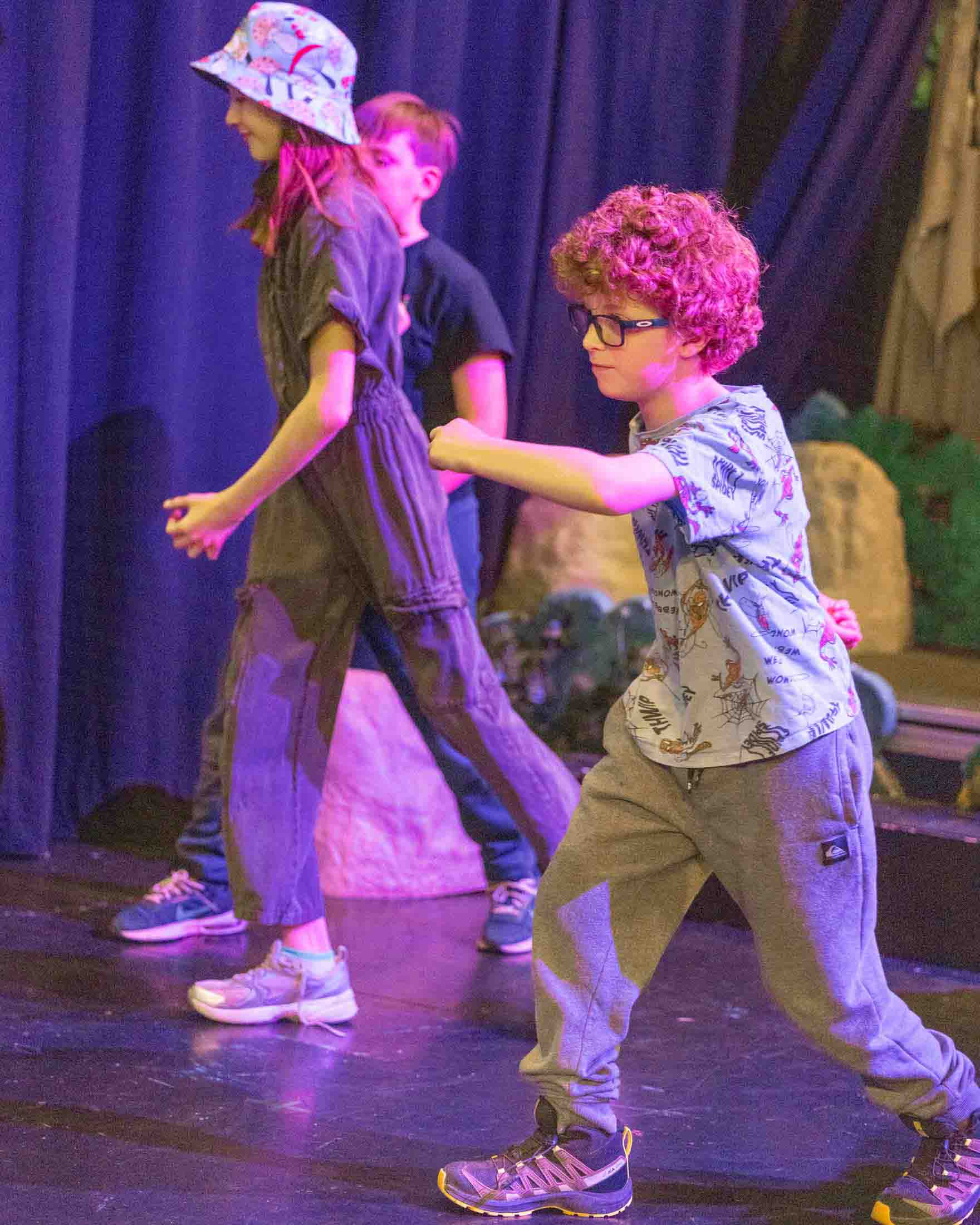 The production’s cast and crew, especially the students, have worked hard to make fantasy a reality. After months of rehearsals, they’re starting to try on their costumes and run multiple scenes without their scripts.
Jenson O., who plays the confident and popular Charming 1, looks forward to their closing night performance. He’s excited to see all his and his peers’ hard work in their final performance, where they can give it their all.
“For me, it’s the thrill of finishing something you’ve worked on for so long. I feel like the play is a very big commitment, and being able to experience that feeling of finishing the show and doing the final closing night is what I’m looking forward to the most.”
Pretending to be someone else can be difficult, especially if that character is completely different from how someone truly is. The Junior School actors have worked extensively on making their characters jump off the script pages.
One student, Yasmin A., has had to play a character almost opposite from her personality. Playing the reportedly evil and emotionally complicated Witch, Yasmin had to trade her kindness for a love of mischief and spells.
“I’m a witch, but I would say I’m a kind person, so I pretend I’m talking to someone else, and I try being way louder and ruder than I think I’m supposed to be.”
A Fairy Tale Springs to Life in December
Amber, Marine, and Opal have their work cut out for them in a few weeks when Witchful Thinking: An Evil Ever After opens at the Black Box Theatre.
Jenson and Yasmin don’t want to spoil the audience but promise an exciting show. It offers something for everyone, including romance, friendship, and goblins playing poker. Jenson hopes the audience feels drawn in by the story and leaves with a smile on their faces.
“I want the audience to feel quite intrigued by the play and just to have a good laugh… towards the end, I want them to think, ‘that was a great play. If I could come again, I would totally do that.'” – Jenson
Watch Calgary Academy’s students take the stage from Dec. 12–14 as they showcase their acting skills and put on an unforgettable production. Don’t worry—there’s still time to snag your ticket!
Visit our events page to get your tickets today!
Sun, Solar, and Science!
Ms. Kim Petersen and the CA Sustainability Committee students are leading the charge to raise funds for a solar panel installation on Calgary Academy’s new Southwest Addition. This is an approved priority project for our 2024–2025 Annual Fund Campaign and is in partnership with Headwater Learning Foundation.
Project Scope: 120 panels, at 600 watts each, generating 76,000 kWh per year.
Cost: Panels and installation cost: $120,000
Here are three reasons why we should support this student-driven project:
- STEAM learning: Students gain experiential learning from planning a solar project installation, and once installed, a renewable energy project on-site can be incorporated into the physics, chemistry, math, biology, and economics curriculum.
- Reduced Energy Costs: Solar panels have little to no maintenance costs and guarantee long-term annual operational savings.
- Lowered greenhouse gas emissions: Solar panels produce no emissions while generating electricity and have a lower carbon footprint.
At CA and HLF, we can combine solar power and giving power! Everybody wins.
Each panel costs $1,000. Would your family support the purchase of a panel, panels, or part of a panel to support student learning?
Donate Now
- Online: On the designation drop-down menu, click HLF Designated Fund – Solar Panels.
- E-transfer: Email HLF’s donation email Please add in the notes/email: Solar Panel Project.
Or reach out to Debra Klippenstein or Shauna Denney for more ways to donate to this or other Annual Fund projects.
Thank you for your generosity,
Your Sustainability and Philanthropy teams
Ms. Kim Petersen, students committee members Karah, Nia, Katie, Megan, Jaya, Hannah, and Grace.
Debra Klippenstein, Shauna Denney, and Angela Gerrish.
Psychologist’s Perspective: November 2024
Happy November
Our school’s theme this month is Agency and Advocacy. Agency is the ability to act independently, make choices, and assert rights, while self-advocacy is the ability to speak up for oneself and communicate needs. Advocating is one way for our children to develop a sense of agency and feel empowered to make decisions about their own lives.
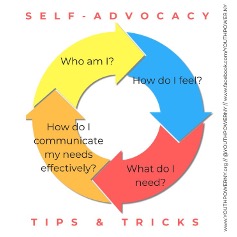
Self-awareness is a key component to being able to self-advocate. We need to know what we want so we can take steps to fulfill these needs. This is a great visual to start the conversation!
Both agency and self-advocacy need to be taught and practiced, and they can be fostered differently depending on the age and stage of our children. Here are some ideas to consider.
- Talk with your child about what they value. What matters to them? What is important? Why? There are many activities online to facilitate these conversations. For example:
- Let your children do things on their own. Resist the urge to jump in when your child/teen is struggling so that they can build skills, self-esteem, and confidence. This may mean that some tasks take longer, and schedules and routines may need to be extended to allow this independence to grow.
- Give your child and teen chores and responsibilities around the house. Even very young children can have simple and safe chores such as putting their toys away in a designated spot. Expect that they can complete these independently and communicate that belief in their abilities.
- Encourage your children and teens to ask for what they want and need at home and in public. Help children understand and identify what they are feeling and then articulate what they need. Model this behaviour (out in public, this could be something as simple as ordering for themselves at restaurants. For younger children, you may need to role-play what they might say to the server).
- Have conversations with your children about the importance of setting boundaries. Help them understand what healthy boundaries look like with friends, family, and other people in their lives. Encourage them to practice setting and maintaining these boundaries. This document may help.
- Help your child understand their strengths and passions. Provide and pursue avenues that capitalize on these. Is there a team or club that they can join? Are there volunteer opportunities that they could pursue?
- Talk openly and honestly about learning and thinking differences. Help your child and teen understand how their brain works and what brain differences may look like in others.
- If your child has a diagnosis of some kind, help them understand what that diagnosis means. How may this impact them? What are some supports that may help them be more successful at home and at school?
When starting with a new teacher, children can complete a 3X3 card and share it with their teacher(s). - Involve your child in conversations about their IPP. Ask them what strategies they find helpful and teach them how to ask for what they need from their teacher. Practice using these strategies at home so that they feel confident and comfortable using them at school.
- Resist the urge to send an email to the teacher advocating for your child. Instead, encourage your child/teen to talk with their teacher and/or send their own email first (obviously, there may be times when we, as parents, do need to jump in, but hopefully this isn’t the norm).
This article has some excellent tips on developing self-advocacy skills. The suggestions are broken down by age and specific diagnoses. Check it out!
Wellness Updates
Grades K–9
MindUp is in full swing. Students have been learning about their Mindful Brain and the stress response. They have also been practicing ways in which they can better regulate their emotions.
If you have questions about wellness programming in Grades K–9, please reach out to Dylan Dean.
Grades 10–12
Students have been discussing this very topic: Agency and Advocacy. They are exploring their IPP and diving into their learning profile.
If you have questions about wellness programming in Grades 10–12, please contact me.
Counselling Services and Wraparound Support
We continue to have a counsellor supporting the needs of our learners in K-8. If you want to have your child connect with her, please reach out to Jenny.
I am here to support the needs of our Grades 9–12 students. If you want your child to connect with me, please reach out.
Lastly, if you have any questions or concerns regarding your child’s learning journey, you can also reach out to our Director of Learning, Erin Ellis.
Serena Braun
Registered Psychologist
From Classroom to Life: WIN’s Lasting Impact
The learning process is incredibly complex. Reading a book isn’t as simple as picking up a novel and turning the pages. There are many steps to recognize and understand words and then put them into sentences. Students can excel in one area of their courses while feeling challenged in another.
Every learner at Calgary Academy is unique, and the WIN (What I Need) program is here to help students receive the support they need. It’s a staple of the Academy program in Junior School—helping students shine through a community approach between teachers, students, and CA’s Learning Team.
WIN, WIN, and WIN Again
Every student brings unique academic strengths to their desks in each class. Reading comprehension (understanding the meaning of something just read) may come naturally for some learners, while others need more time to process the same information.
Everyone has varying challenges in learning, whether in math, science, or another subject, but with dedicated effort, students can improve many of these foundational skills.
However, scheduling individual work time while covering the necessary course content in class can be difficult. The average school day is jam-packed with different courses.
This is where WIN comes in—a block of time for students to address their growth areas to benefit their daily classes. With built-in time in the school schedule, students receive much-needed support. Calgary Academy’s Director of Learning, Erin Ellis, understands the value WIN has for young students.
“For many students, the allocated WIN block allows for extra time practicing specific skills that are foundational for achievement in grade level curricular outcomes.” – Ms. Ellis
A typical WIN session involves a group of students, often from different classes, working together with their teachers to progress on similar skills. The expertise of CA’s Learning Team shines in these sessions, which feature support in writing, numeracy, and reading for students’ individual needs.
Ms. Ellis notes that WIN encourages a community of learners at Calgary Academy. Classrooms can work alongside the Learning Team to split into small groups, each focused on a specific student growth area.
This approach to learning has been a pillar of the school since the 1980s. In the past, this concept was referred to as remediation, but WIN better emphasizes the incredible work done at the school.
“What I Need introduces an element of demystification for learners in that they explore a strengths-based approach to better understand their academic challenges.”
Preparing for Now, the Future, and Beyond
WIN is present throughout Junior School at Calgary Academy, providing students with several years of support to work on foundational skills before they enter Grades 9–12. Academic data helps CA teachers identify what focus children need during their WIN sessions.
Data from previous schools, assessments, standardized testing, and the teacher’s expertise help guide WIN groupings. According to Ms. Ellis, these created smaller groups are intended to stay together for several weeks, but students may move as their academic needs grow.
As children move through the grades and enter Senior School, their time in WIN can inform learning strategies or accommodations (assistive technology, extra time on tests, modified instructions, etc.) students can use. These accommodations are essential for many people as they graduate from Calgary Academy and possibly pursue university.
Learning is a complex process, and everyone has strengths and challenges. However, dedicated time and support can help students improve these skills, better understand their learning strengths, and identify what assistive technology they may need.
With WIN, Ms. Ellis understands its impact extends beyond the classroom—it helps set students up for success for the rest of their lives.
“Scheduling daily WIN provides a structure for targeted foundational skill development. This is essential in the younger years. As the complexity of curriculum increases, the WIN focus can shift to incorporate executive function skills that consider study and test-taking strategies… those tools that influence their post-graduation years.” – Ms. Ellis
Camp Connect: The Importance of Building relationships
Approximately 45 minutes away from Calgary Academy and located right by Sibbald Lake is Camp Connect, which many CA students have visited this October. While CA students have gone on bonding trips many times over the years, it’s become an increasingly vital part of fostering connections off-site.
The camp has amenities galore for visitors—archery targets, low ropes, gaga ball pits, and space for a warm and comfortable fire. Surrounded by beautiful scenery, it’s the perfect place to relax and make lasting memories.
Camp Connect has been the place for connection between Calgary Academy students and teachers for the last month. Junior and Senior School classes have all spent whole-day bonding trips at the camp to set a strong foundation for the school year.
One Day at Camp, Year-Long Memories
While academics are the focus of education, effective learning is more than remembering course content. Relationship building is crucial for every classroom, regardless of age, grade, or subject matter.
Students spend hours in their classes each week, and feeling comfortable asking questions or requesting support can make a significant difference in their schooling.
Senior School teacher Zach McDonald (who planned the Grade 10 trip) understands the impact community can have on someone’s school experience. Having relationships with students throughout the school makes him an approachable and reliable teacher.
“I think what sets Calgary Academy apart from other schools is the sense of community here… we’re always going to care about academics, but in order to be successful, we have to have really strong relationships.” – Mr. McDonald
Mr. McDonald and the Grade 10 teachers and students visited Camp Connect in early October. They spent a day playing disc golf, practicing their archery skills, making crafts, navigating the low ropes course (a favourite for Mr. McDonald), and finally, sharing a meal together before eating marshmallows around the campfire.
The Grade 10 teachers split students into small groups, allowing them to make new friendships and mingle outside their regular classes. These same connections and relationships have developed throughout Calgary Academy.
The Grade 7s visited Camp Connect on Oct. 7, and Junior School teacher Emilie Haensel, who planned the activities for their grade, noted how beneficial the trip is for the start of the school year.
Classrooms can dive headfirst into their course content but spending a day outside getting to know each other can break the ice between students and their teachers. Ms. Haensel remembers the words she learned when first starting at Calgary Academy: “when you have a strong relationship with your students, the rest falls into place.”
With a background working at summer camps, Ms. Haensel planned a variety of activities, from making bead lizards at arts and crafts to a grade-wide round of animal tag, where students pretend to be herbivores and carnivores and try to tag each other while hiding in Camp Connect’s surrounding forest.
Many students step out of their comfort zones on these trips, getting to show a different side of themselves. Students can be silly, make jokes, and see their teachers differently than before.
“For the students who might find school to be a stressful place, they can go to camp and think, ‘now I get to be myself, and my teachers get to be themselves.’” – Ms. Haensel
With a month of Camp Connect trips having come and gone, Calgary Academy teachers are looking forward to more grade-wide activities. Community and relationship building is essential throughout the year, and the teachers have plenty planned for the year.
Mr. McDonald looks forward to planning more events this school year. His students have already asked when they’ll return to Camp Connect.
He believes that “sometimes, students just need a break.” A day away from the classroom can help students come back refreshed and with a greater appreciation for their classmates and teachers.