
Psychologist’s Perspective: June 2026

Welcome to June! I don’t know about you, but for me, this school year has zipped by so quickly. It is hard to believe it is almost summer break.
I know that many of these newsletters have focused on anxiety, and I would like to continue talking about how we, as parents, can best support our children who struggle in this area, especially as we head into the summer months. I recently attended a two-day conference based on a parent program called SPACE (Supportive Parenting for Anxious Childhood Emotions). SPACE was developed by Eli Lebowitz, and since I previously read his book, Breaking Free of Childhood Anxiety and OCD, I was excited to take this training. I would like to share some key points of this training with you.
According to their website, “parents who participate in SPACE will learn skills and tools to help their child overcome anxiety, OCD or related problems. The treatment focuses on changes that parents can make to their own behaviour; they do not need to make their child change. The two main changes that parents learn to make in SPACE treatment are to respond more supportively to their anxious child and to reduce the accommodations they have been making to the child’s symptoms.”
According to SPACE, there are two common (and not so helpful) responses that parents may have to their child’s fears: protecting and demanding.
Protecting
- Thoughts and behaviours that centre around the goal of protecting our child from harm or distress. Becoming “the protector” when our child isn’t really in danger.
- Communicates that the worry really is THAT big and that our children can’t cope with it.
- Reinforces the anxious belief.
- Prevents our children from having the opportunity to see if the fear was actually warranted.
- Things we might think and say: “My job as a parent is to make my child’s life as comfortable as possible. I want to help my child feel good all the time. They shouldn’t have to struggle.”
Demanding
- When we expect our child not to feel anxious, or to act as if they are not feeling that way.
- Demanding that our child feel and do differently in a subtle (“no, honey, this isn’t actually scary”) or a more extreme way (“stop being such a baby”)
- Things we might think or say: “He’s just looking for attention. Stop being so dramatic! See, this is not scary!”
How do we help our children then? By offering support:
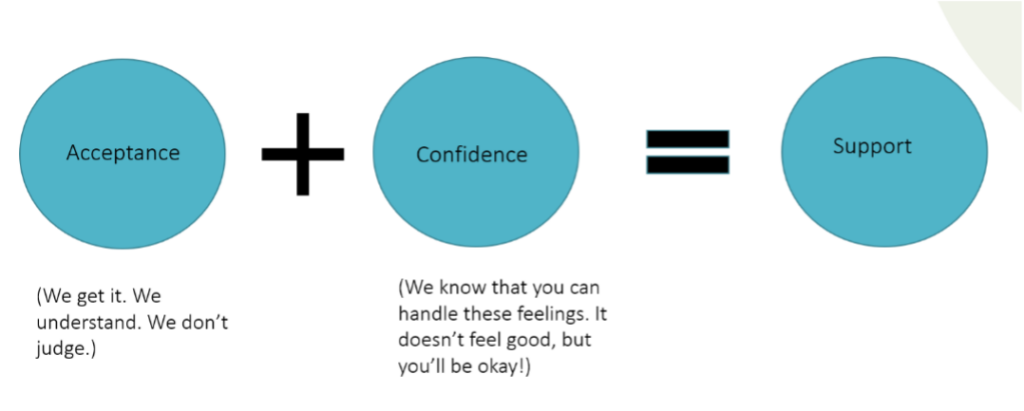
We communicate acceptance and validation of their feelings (even if they don’t make sense to us), and we express confidence that they can get through this moment of fear and anxiety.
In addition to protecting and demanding, most families of children with anxiety engage in accommodations that only make the anxiety worse. Accommodations are changes parents make in their own behaviour to help their children avoid or lessen feelings of anxiety. For example:
- Letting our child stay home because they feel anxious (anxiety does present somatically, so they might truly feel sick. We have to remember that it’s not dangerous, just uncomfortable.)
- Answering every text message/phone call and providing reassurance.
- Waiting in the parking lot in case our child wants to go home.
- Asking a teacher to postpone a test because our child is too anxious.
- Letting them sleep with us because they are afraid to be away from us.
- Following them from room to room because they don’t want to be alone.
Remember, the opposite of accommodation is “normal.” If you are not sure how you are accommodating, ask yourself the following:
- Is this something I do because of my child’s anxiety?
- Does my child become more anxious if I don’t do it?
- Do I do the same for my other children? Would I do it for another child?
- Do I feel as though I have no choice but to do this?
- Do most people do this for their child at this stage?
- Have I tried to stop it?
If you have a child with anxiety, I encourage you to take some time this summer to observe the way in which you respond to their fears and worries. Are you protecting? Demanding? What accommodations are in place? What is one accommodation you could change/remove? And remember, it is in our nature to want to help our children. Through this process of noticing, we are trying to recognize the things we have done to help our child (and our family) get through the day.
Once (or even before) you have identified these accommodations, I encourage you to access Eli Lebowitz’s book Breaking Free of Childhood Anxiety and OCD, as he breaks down the next steps in reducing/removing accommodations. He provides guidelines for choosing which accommodation to tackle and explains how to express this information to your child. We certainly don’t want to change anything until we have a plan in place to communicate with our child and know how to respond to them when they aren’t fans of the ‘new plan.’
As Eli Lebowitz puts it, “children who have come to rely on accommodation for help in coping with anxiety often will think of the accommodation as the only means of coping. As long as your child remains hopeful that you may provide the accommodation, they are much less likely to try out other ways of coping. Once your child sees that you are definitely not going to accommodate, she is more likely to find other, more independent means of regulating her emotions.” (Breaking Free of Childhood Anxiety and OCD, p. 134)
I hope you are able to enjoy the summer with your family, spending some tech-free time together, and enjoying the outdoors. Practice being truly present with one another. And start the journey of noticing. What am I doing for my child that they can actually do for themselves? How might I communicate confidence in their abilities and their resilience?
Counselling Services & Wraparound Support
As we move into summer and then a brand-new school year, please reach out to our Head of Student Supports, Paige McDonald, if you have any questions or concerns regarding your child’s learning journey.
Summer Supports
Isabelle Joiner: Learning Through Exploration
After graduating in 2020, Isabelle Joiner (2017–2019) is used to change. In the six years since graduation, she has travelled through 25 countries and five continents.
However, she isn’t taking a vacation—these countries are her classroom, a way to experience different cultures and learn about fibre arts and natural fibres.
The Beginning of Many Future Journeys
Isabelle always wanted to travel the world and explore. During her time at Calgary Academy, her 2018 trip to Vietnam through International Travel Studies (ITS) was a glimpse into her future.
She had been to the United States and Europe before, but during ITS, she was in a drastically different climate, culture, and way of life.
She remembers their day visiting street markets and trying local foods—the best meal of her trip—a vivid memory.
“I did the Vietnam trip in 2018. It was a huge influence on my inspiration to travel. It was the first country that I’d been to that was very different from where I lived.” – Isabelle
She is still chasing the feeling from Vietnam, sitting at a hole-in-the-wall restaurant and taking in another place in the world.
After her immediate post-graduation plans fell through, she found some local work. Eventually, she heard about au pairs, who could live with a host family to provide child care and learn about the country. After meeting a good host family, Isabelle lived in France for two years (with a brief summer in Budapest).
After France, she then lived Hawaii for five months before heading to New Zealand, driven by a passion for fibre arts (such as textiles and weaving).
“My grandma taught me to knit when I was four years old. Fibre arts have always been a part of my life and something I’ve naturally been drawn to…I can’t remember a time when quality materials and fibre arts weren’t present in my life… Growing up, I always knew I wanted to do something connected to this passion.”
Real World Learning
When Isabelle became interested in fibre arts and natural fibres, she decided to “make the world her classroom.”
“I decided that I wanted to carve my own educational path within natural fibres and fibre art through travel and hands on experience.”
As part of her fibre travels, she started learning in New Zealand as a wool handler. A woolhandler’s job is to sweep wool to help support the shearer and sort the different parts of a fleece into their respective bins so that the farmer can get the best price for their wool.
Isabelle road tripped across the country, hiked, and got to know her new friends, who taught her about their culture.
“The people are so friendly. It was so much fun to work with mostly Māori people, learn their culture and language, and eat all their food. They were so excited to share everything with me.” – Isabelle
A cultural experience Isabelle’s friend told her she couldn’t miss was the Golden Shears World Shearing and Woolhandling Championship. This competition is hugely popular in New Zealand, taking place every three years, and people fly across the world to participate.
They decided that the best way for Isabelle to experience the Golden Shears was to enter the competition. During the competition, Isabelle competed in wool handling, a competition testing speed, precision, and technical knowledge of a fleece. Having only worked in the industry for three months and being one of the least experienced competitors from various countries; she won the novice category.
“I gave it my all and ended up winning, which was even crazier because I never expected to win. After the announcement, they whisked me away to the media room and interviewed me. I was getting messages from everyone that I met from the industry because it was live-streamed, everyone was watching it.” – Isabelle
Isabelle showed off her skills for everyone watching, winning the Golden Shears in the novice category. It was a perfect way to end her time in New Zealand.
Looking Forward
Isabelle has now spent the last few weeks in Indonesia, exploring the country and learning about natural dying. Soon, she departs for Mongolia for an internship, where she will work in sustainable cashmere, yak, and camel production.
As she continues her self-guided education, she takes a lesson from her CA days: stay curious and know that there is always a different way to learn. She encourages anyone interested in international travel to follow their heart.
“Trust your intuition and go for it! Things can go wrong, but somehow, they work out, and there are kind people everywhere in the world, no matter where you are.”
Alumni Spotlight | Trevor and Nancy Anderson
Coming from a family with green thumbs, Trevor Anderson (’98) knows that each fruit, vegetable, and legume finds its own way to sprout. When you take care of your garden, you can grow incredible things.
That’s exactly what Nancy Anderson did when she cared for her son’s education. She found him a place where he felt accepted, but that feeling doesn’t happen right away. It’s discovered in moments of understanding and in places that feel accepting.
Sometimes it looks like a classroom at Calgary Academy, and other times it looks like open land, fresh air, and space to move freely.
Finding a Refuge
Trevor remembers feeling like the odd one out in middle school. He was known as the hyper, distracting student in class.
His mother, Nancy, saw Trevor much differently. He was athletic, energetic, curious, and loved being outside.
“He was really inquisitive and athletic and had lots of energy. So, he would always be doing things a little differently than other children.”
As Trevor grew, it became harder for him to stay seated and focused during class. After he was diagnosed with ADHD, it was a journey navigating understanding as they looked for a new school that could better suit his needs.
He started at Calgary Academy in Grade 9 and graduated in 1998.
In the 28 years since graduating, Trevor remembers the feeling of finding a place where he belonged more than any specific lesson from school. His classmates had similar school struggles, and he remembers being taught by neurodiverse teachers—ones that helped him see a future for himself.
“I don’t think I would have finished school. I don’t think I would have gotten nearly as far in life as I have if not for Calgary Academy and my mom… It was great because we were all in the same boat, and the teachers made you feel more normal.” – Trevor
Growing His Own Future
Nancy tried to share all the information she had on ADHD and neurodiverse learning with Trevor’s teachers in the 1990s. Her son wasn’t a troublemaker because he didn’t want to listen or focus during school—he had his own way of doing things.
“Society has that stereotype, that if you’re not coming in from recess at other schools because you’re picking up something on the playground to take it to the office, you’re misbehaving. The teachers think, ‘oh, that kid is never doing what he’s told,’ instead of having compassion, because he returned a sweater or something left outside.” – Nancy
Over time, Trevor has learned how he works best as the owner of Lil Green Urban Farm, which provides fresh produce to Calgarians through the city’s Farm Stand program.
Working as a ranch hand gave Trevor an appreciation for the land. Nancy owned a flower shop, and his family had always gardened. Trevor enjoyed spending time outside, and he followed his passion for agriculture to Olds College.
After graduating and moving in with his wife in Calgary, Trevor knew he wanted a farm, so he found a way to make it happen. Growing produce in six backyards across the city, he began operating Lil Green Urban Farm.
Eventually, he needed more space and found some farmland 20 minutes outside of the city. He’s still there today, and it has become another safe space for Trevor—a place where he can be in his element around quiet nature.
“You’re 20 minutes out of the city. There are no signs of the city, sounds, or smells. For me, it’s important to be in a comfortable, happy place… Being able to get out of the city to get my work done was huge.”
Supporting Her Son, No Matter the Age
Nancy sold her flower shop in 2022 after working in the business since 1992. It was time for her to “slow down,” so she decided to write a children’s book based on Trevor, titled One of a Kind Kid.
She remembered all the times she fought for her son’s learning needs and felt inspired to write a children’s book.
“I decided that people who are never going to read about ADHD in depth would benefit from a little book that helped them to understand and relate to people with ADHD. I also thought that children who felt misunderstood would be able to relate.” – Nancy
Trevor can still relate to the book today—he jokes that he has the “classic ADHD work ethic.” If he has an abundance of produce, he may stay up all night pickling to get it done.
While he can joke that he’s still the same student he was, Nancy sees the hard work that Trevor has put in since he was a child.
“Trevor is far more capable than he gives himself credit for. He works incredibly hard and has at everything he’s done over the years. He takes a negative situation and doesn’t walk away from it.”
Nancy has always advocated for her son and instilled an important lesson in his life: you don’t need to live life the way that others think you must.
You can find what you love doing and how you want to do it if you have someone there to cheer you on. Whether it’s your family, friends, or school community—CA is proud to support students like Trevor.
You can find Lil Green Urban Farm by checking out Calgary’s Farm Stand program.
Meet Our People: Paige McDonald
Calgary Academy’s Head of Student Supports, Paige McDonald, has worn many hats during her career. Since becoming a psychologist in 2019, her work has focused on helping students succeed in school and life.
Her curiosity and love of learning have led her far. From the world of executive recruitment to supporting unique learners at CA, Ms. McDonald is in a place where she feels excited to make an impact each day.
Finding Her Passion
With a degree in economics, Ms. McDonald helped build Boards of Directors, finance teams, and other leadership groups for 13 years before becoming a psychologist.
When her daughter began struggling in school, she was surprised. Her child was bright, but her psychoeducational assessment revealed a diagnosis of dyslexia, which explained her difficulty with reading.
Researching as much as she could about learning differences to better understand her daughter’s needs, she kept thinking, “how many people have never had a chance to reach their potential because someone decided they weren’t smart?”
Ms. McDonald decided to learn everything she could about how the brain develops, and eventually earned her master’s in counselling psychology. .
After her convocation, she worked at a school for several years before joining Calgary Academy this past fall. She had always heard about the school and felt excited about a new opportunity.
“I knew that there were some very talented people here, saw the job posting, and it was really interesting… Honestly, I was so impressed by the Strategic Plan that I thought, ‘if they do half of what they say they’re going to do, that’s going to be a pretty exciting place to be.’” – Ms. McDonald
Holistic Support
Ms. McDonald has an inclusive philosophy regarding the school’s student supports. While CA has smaller class sizes and well-structured programs, each learner is unique. What works for some doesn’t work for everyone.
She notes that while support can focus on individual skills in isolation, it’s important to prepare students to work effectively in group dynamics.
“Our teachers are very knowledgeable, so when we’re identifying kids who are in highly supported structures but still need additional support, the idea is to come in and look at how we set them up for success. Often, support is looked at as, ‘pull them out of class and let’s do one-on-one work,’ when really our goal is to build skills for the classroom.”
She sees her colleagues, who include the literacy, numeracy, speech-language pathology, wellness, occupational therapy, and counselling teams, as the “glue” of the school. They help ensure a student’s needs are met across all classes and provide individual support for learners.
With her background in psychology, Ms. McDonald recognizes how all aspects of a child’s life can affect their learning. Daily classes will not solve every struggle, and she understands that schools and families must work together.
“If a student is struggling with seeing themselves as a learner, it doesn’t matter how many foundational skills we put in. We have to look at all the pieces surrounding the student. That, of course, works best when we have parents and guardians coming alongside and working with us.” – Ms. McDonald
Mastering a skill takes time and repetition, and it can become easy to get lost in the expectations of where a child’s learning should be. What matters is finding the support a student needs to begin their growth.
To Ms. McDonald, seeing students overcome challenges after their hard work is the best part of her job.
“Seeing a student where it just clicks, and they’re like, ‘I can read,’ and they surprise themselves. Or the child who’s really struggling with peers, and then you overhear them in the playground using emotional vocabulary and problem-solving and then go off and play. It’s incredible to watch.”
ITS Thailand | Lessons from Southeast Asia
Beautiful Buddhist temples and busy streets were common sights around Bangkok and Chiang Mai as CA students and staff explored Thailand.
One of this year’s International Travel Studies (ITS) trips took 18 students across the world, where they learned about Thailand’s rich culture while making an impact in the local community.
13 Days in Thailand
In 13 days, the ITS travellers journeyed over 25,000KM between Calgary, Bangkok, and Chiang Mai. That only includes the flights—the group also travelled by boat, bus, and on foot as they went from the south of the country to the mountainous northern end.
 They started by navigating the hot, humid streets of Bangkok before heading to Chiang Mai and its surrounding mountains. This was the destination of their altruistic travel project at Boonthong Orphanage. However, their journey into sustainable tourism had many stops along the way.
The students visited and supported staff at Elephant World, a sanctuary for elderly, abused, or disabled elephants. They fed and helped bathe the elephants (while getting covered in mud themselves). In Chiang Mai, the ITS travellers visited PooPooPaper Park, where they learned about eco-friendly paper products from elephant waste.
CA teacher and one of the trip supervisors, Jane Conrad, remembers seeing the wonder on the students’ faces when they saw the elephants up close. Grade 12 student Ian D. agrees that it was a magical experience—the highlight of his trip.
“My favourite moment on the trip was undoubtedly our time at the elephant sanctuary. It was a rare experience to feed and care for the massive and gentle animals.”
When they weren’t learning about elephants, the group explored temples and stunning architecture, as the group visited local cultural sites, like Thailand’s royal palace and Wat Pho, the oldest temple in the country.
With one of the largest Buddhist populations in the world, visiting sites like this helped the travellers better understand Thai culture.
“Visiting the temples just gave us a better understanding of what the Thai people believe about respect. And also, how Thai Buddhism makes its way into everyday life, like, everywhere. When we went through the flower market, it was also a place to make wreaths so that people could make offerings at the temples.” – Ms. Conrad
Paper Ranger
Day five of the trip brought ITS to Paper Ranger, a social project started by university students who found a simple way to create notebooks for disadvantaged children.
The group spent their morning supporting the project—making notebooks and designing their own cover art. Ian remembers this being a humbling experience, but one that gave him the chance to help those less fortunate.
“Through my experiences at places like Paper Ranger, I became more aware of how fortunate I am to live in Canada, with access to family, education, and basic necessities. At Paper Ranger, we helped make notebooks, which surprised me, as I had always assumed school supplies were readily available to students.”
Boonthong Orphanage
On day 10 of their journey, the ITS students arrived at Boonthong Orphanage. Located 10 KM from Chiang Mai, Calgary Academy has visited the orphanage on past Thailand trips.
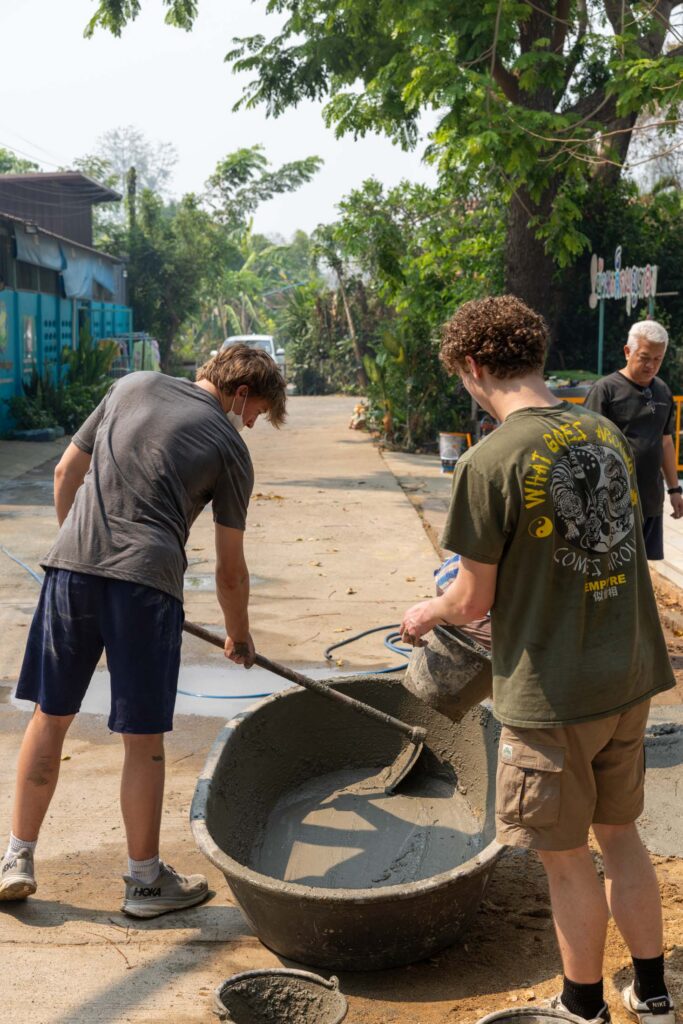 During their two days of work, the travellers poured concrete, helped craftspeople build a balcony for the children, and touched up the building’s paint.
“I think understanding that these things benefit real people… There are tangible contributions students can make. You can pour concrete, you can paint and do things that improve a space. There are also the intangible impacts through personal connections, like giving a child a piggyback ride and spending time with them.”
On their second day, the group completed their work before celebrating with the orphanage that had welcomed them. The students brought gifts for the children, from Canadian souvenirs to school supplies.
Ian felt motivated to help wherever he could during the project, and he tried to repay the kindness of their hosts.
“I spent a lot of time painting, working on the rails of the deck and adding fine details around the lettering on the walls, as well as helping mix and pour concrete. However, the most meaningful part of the experience was spending time with the kids. Despite the language barrier, we were still able to connect and share joy.” – Ian
Heading Home
While ITS Thailand was an incredible experience for the travellers, they eventually had to return home. However, the students took home life-long memories and lessons.
Ian is glad to have left an impact, however small, on those he met on his journey through the country, especially at the orphanage. Now back in Canada, he feels grateful for the life he has and his experiences over Spring Break.
“One of the most important lessons I took from this experience is to remain grateful for the life I’ve been given, to value the support of my family, and to know that the necessities I often take for granted are more than enough. Seeing how others live gave me a new perspective.” – Ian
Next school year, another set of ITS trips will take off for another year of memories. For students entering Grades 10–12 next academic year, there’s a chance to join!
If you’re interested in learning more about ITS, including details on the three trips offered for Spring 2027, attend the virtual session on Monday, May 4, at 7:00 p.m.
Learning on the Mountain | CASSC Students Become Instructors
The Rocky Mountains are home to the bowls and tree lines that host the student athletes of the Calgary Academy Ski and Snowboard Club (CASSC). Grade 10 student, Nelson S., hops off the ski lift into the morning sun, making his way to the top of the mountain.
He confidently skis down, carving through the snow on his first run of the day. This has been his average Monday for the past six weeks.
Nelson is one of several Senior School students who recently completed their Level 1 CSIA (Canadian Ski Instructors’ Alliance) Snow Park Certification Course. Their certification allows them to potentially get jobs working as ski instructors.
Officially trained to teach skiing through the CSIA program, he has spent this CASSC season learning on the mountain.
December to April = CASSC Season
Nelson first hit the slopes with CASSC last year as he settled into his classes, having joined CA that September. His parents encouraged him to join and make some friends in his first year at CA.
 He had been skiing his entire life, and this was an easy way to meet other students with a similar passion. From December to April, Nelson and other school skiers load onto an early morning bus and head for the mountains.
CASSC days are some of his favourite days—ones spent with friends at Lake Louise Ski Resort.
“I like being with friends and just skiing all day.”
To help balance between school and snow, Nelson’s teachers provide him with advanced work. He would find time to complete his assignments and review his notes. He’d sometimes sacrifice his lunch hour to study so that he could ski on Monday.
School work doesn’t stop on CASSC days, and Nelson and his fellow skiers are responsible for staying on top of their classes.
CA teacher and CASSC founder Lanny Donde explains that the Level 1 certification goes beyond skiing skills. They had to learn how to teach others and maintain a safe environment.
“Some of these students don’t even have a driver’s license. This certification is like their first little badge of adulthood—a sign of responsibility. Like, if you do get this job, you’ll be responsible for 6 to 10 children. That responsibility kicks in a little bit more when they take the course, finish it, and realize what its implications are.” – Mr. Donde
Learning Skills for Life
The CSIA Level 1 certification is the first entry for skiers into instruction. A three-day course at WinSport taught students everything they need to know to teach new skiers the ropes.
Everyone in the program received coaching on their technical skills and teaching skills in:
- Safe teaching in a terrain park
- Canadian teaching approach
- Switch skiing, boxes, basic airs, grabs and 180° spins
- CSIA technical concepts
- Park etiquette and safety awareness
- Guest service and communication skills
As they prepared for their testing, Nelson found that reminders on his fundamentals helped him.
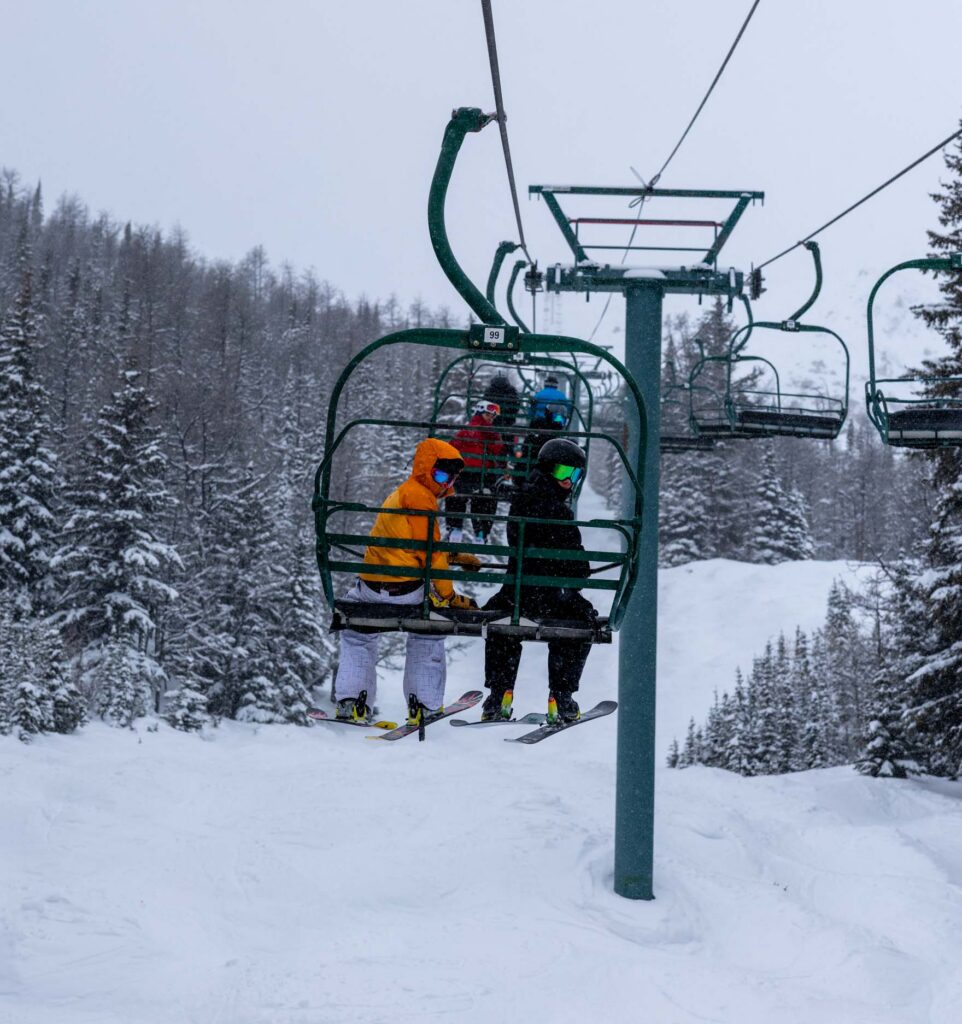 He felt inspired to pursue his certification because he skis frequently with younger children from his family and friends, and because of the job opportunities.
“It’s just good to put on your resume, and to be able to know what to do on the mountain and how to help people who are skiing.”
Mr. Donde has been proud of all 12 students for their accomplishments this year. Students in CASSC are strong skiers, but working on their skills with coaches each week prepared them for their certificate testing.
He hopes they can use their new certification to enter the workforce or, over time, increase it to levels 2 and 3.
“I’m really proud of the fact that we can give them an employable skill—it’s an amazing resume builder. A lot of these kids have zero experience, so it’s good that they can show an employer that they’ve got something that’s professional and internationally recognized. It could open up a career these students never even thought was possible.” – Mr. Donde
Looking Forward
As Nelson reflects on his recent certification, he hopes to secure a seasonal job with his qualifications.
“I’m going to put it on my resume. I’m doing the WinSport volunteer program in the summer, and I hope to get hired as a ski instructor in the winter.” – Nelson
In the meantime, he encourages anyone who can to give skiing a try.
“There are so many different options, like just learning on the bunny hill, or you can be super advanced. I think it’s good to give it a try—if you don’t like it, you don’t have to do it!”
Learn more about CASSC, and see if it’s right for you or your child.
Volunteer Opportunity | Help a Fellow Family!
Each year, 30–40 students are financially supported to attend Calgary Academy thanks to generous donor support combined with the hard work of Calgary Academy Parents Association (CAPA).
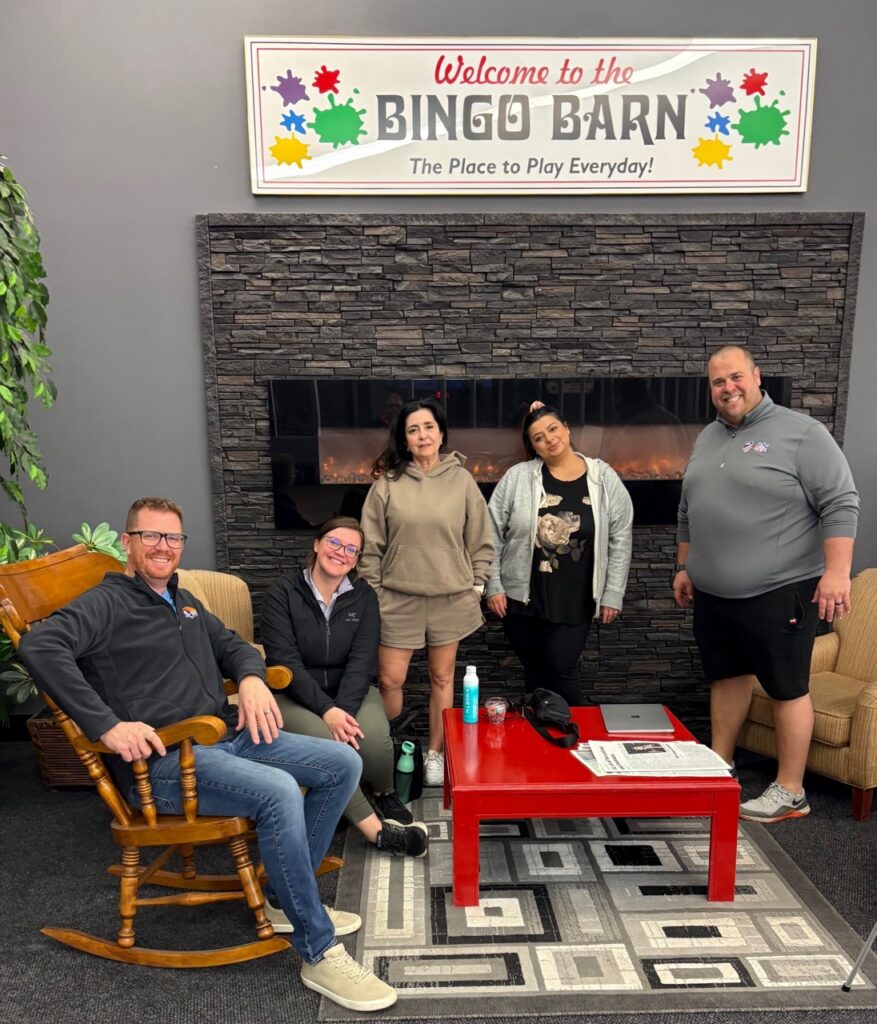
CAPA’s bursary fundraising is vital for these students and their families. But it is also time-consuming, as funds are raised from bingos and casino staffed by CAPA parents and volunteers. You can support a fellow parent today by signing up to work a CAPA Bingo.
Taking a shift can ease the load on bursary families who have several volunteer commitments per month, which staff members like Advancement & Alumni Relations Coordinator Angela Gerrish volunteer at throughout the year.
“I love spending an evening working a CAPA bingo. I know my time gives a parent time back with their child. It’s important to me to support every family and student at CA, and this is one tangible way I can do that.” – Ms. Gerrish
You can help bursary families by volunteering to take a shift in their place. A single shift equals $200 in bursary assistance—and gives another CA family a break.
Your generosity helps families who dedicate many hours to CAPA events in support of their child’s education.
Ready to Join the Fun?
Volunteering is open to parents, extended family members, and community supporters. CAPA welcomes anyone over 18 who is willing to get involved by signing up for a shift at an event. You can give the gift of time to families, offering them an evening with their loved ones while you connect with other members of the CA community.
CAPA participates in casino events every 18 months, while bingos happen monthly. Each volunteer shift is five hours, and available times include:
- Weekday afternoons (10:30 a.m. to 3:30 p.m.)
- Weekday evening (4:30 p.m. to 9:30 p.m.)
- Weekend afternoon (10:30 a.m. to 3:30 p.m.)
- Weekend evening (4:30 p.m. to 9:30 p.m.)
Your time helps ensure CAPA can continue providing bursaries that help students to learn, grow, and succeed at Calgary Academy.
Fill out CAPA’s Bingo Interest Form to sign up for a shift. You can work as many bingos as you want. Why not start with one so you can understand the impact? A CAPA representative will be in touch with available volunteer dates and next steps.
How CAPA Bursaries Help Students
 Since 1986, CAPA has helped raise money for students with specialized learning needs. Bursaries directly assist students who benefit from a supportive learning environment, offering them the chance for personalized instruction from teachers who understand their needs.
These bursaries are funded through volunteer efforts at different gaming events across Calgary, including raffles, casinos, and bingos. Families who receive bursaries commit to volunteering at monthly events that help sustain the bursary fund.
Because CAPA is volunteer-run and raises more than $100,000 each year through fundraising events, every hour contributed directly impacts students.
If you have any questions, contact CAPA directly.
Psychologist’s Perspective: March 2026
Happy March! Spring is just around the corner. It is a time for new beginnings and rejuvenation. I am looking forward to the break ahead, as I am sure many of you are as well.
This month, we are talking about the relationship between anxiety and Attention-Deficit/Hyperactivity Disorder (ADHD), Autism Spectrum Disorder (ASD), and Specific Learning Disorders (SLD).
Many of these diagnoses coexist, which makes understanding and providing appropriate supports absolutely essential.
Anxiety
First, let’s take a closer look at anxiety. Anxiety happens when a part of the brain, the amygdala, senses trouble. When it senses a threat, real or imagined, it surges the body with hormones (including cortisol, the stress hormone) and adrenaline to make the body strong, quick, and powerful. This is the fight, flight, and freeze response. This response has been keeping us alive since the beginning of time. It’s what strong, healthy brains are meant to do.
An anxious brain is a strong, healthy brain that is overprotective. It tends to sense a threat where there is none and hit the panic button ‘just in case.’ This sends an unsuspecting body unnecessarily into the stress response. This stress response happens automatically and instantaneously, sending neurochemicals surging through their bodies, getting them ready to hide, fight, or flee; anything that will keep them safe.
For children with anxiety, any situation that is new, unfamiliar, difficult, or stressful may be seen as a potential threat. And we don’t want to parent anxiety! Ask yourself, who am I responding to? Anxiety walks and talks like my child, and yet, there are some key giveaways that tell us that it is anxiety and not our child:
- Anxiety seeks reassurance and safety: comfort me!
- Anxiety seeks solutions: solve my problems!
- Anxiety seeks predictability: don’t change!
When we see these flags, we can say to our child, “let’s you and I have a conversation with anxiety and
remind it you are strong and courageous. This does not feel very good right now, and that is okay. We
can sit here together and feel uncomfortable.” As parents, we want to avoid getting sucked into the cycle of anxiety. We don’t want to let it argue its case that our child is not capable. They are more than
capable! Check out this visual from The OCD & Anxiety Centre:

Learning and Executive Functioning
When a child is feeling anxious, their rational, thinking brain is hijacked by the amygdala. That means that no learning can occur until the child can manage these feelings, regulate their nervous system, and talk back to anxiety. Anxiety is extremely predictable, so we do know when it is going to show up. “Hey, anxiety, what a surprise that you’d show up when I am about to write a test. So predictable!”
So, what is the relationship between anxiety, ADHD, ASD, and SLD? Within the three neurodivergent profiles we discussed in previous newsletters, we learned that executive functioning skills (such as task initiation and follow-through, planning/organization, working memory, performance monitoring, inhibition of impulses, and self-regulation) are often delayed by 3-5 years. Anxiety, a psychological factor, just adds another layer of impairment to those skills, making listening, learning, and thinking rationally even more difficult.
What can we, as parents, do to support our neurodivergent learner(s) who may also deal with anxiety?
Here are five top tips:
- Continue to grow our understanding of the common differences seen in those with ADHD, ASD, and SLD. Maintain the notion that our children want to do well and endeavour to find out why they may be struggling.
- Remember that all behaviour is communication. Be a detective with your child and calmly ask questions to find out more.
- If we are dysregulated, we cannot coregulate with our child. When we feel emotionally escalated (and what parent doesn’t from time to time), we need to step away and find ways to calm our nervous system before re-engaging with our child. Modelling that skill is also really important. “I was feeling really frustrated, so I went for a short walk to feel calmer. Now, let’s talk if you’re ready.”
- Provide executive functioning support at home. Check these links for tips to support EF skills development:
- Remember that while we want to scaffold supports to accommodate our neurodivergent child, we do not want to accommodate anxiety. Anxiety isn’t dangerous. It can be uncomfortable and distressing, but it is not harmful. Further, our children need to learn and practice skills that will rewire their brains and help them become less overprotective! Practicing these skills regularly is the key to success. It lays the foundation from which to pull in moments of anxiety. Note: You may wish to teach your child TIPP skills for moments of extreme anxiety.
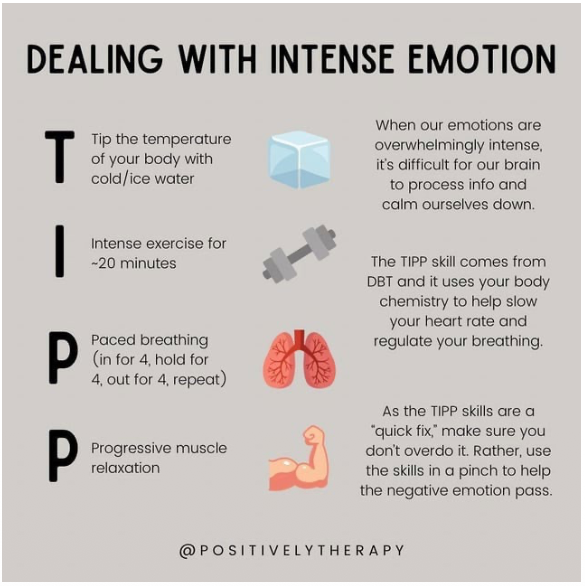 Source: Dr. Becca @positivelytherapy on Instagram
A Note About Diagnosis
While anxiety commonly walks alongside ADHD, ASD, and SLD and all of these diagnoses have many overlapping characteristics, they are distinct diagnoses with differing reasons for the behaviours we may observe. Because of this, we must collaborate with trained professionals who take a detailed history so they can tease out what may be causing challenges for our child and then make appropriate recommendations.
This website provides excellent visuals to explore these differences and similarities: ADHD Infographics | Visual Guides by Neurodivergent Insights
Additional Resources
- Untangling ADHD and Anxiety as Comorbidities – The REACH Institute Anxiety
- CHADD – Improving the lives of people affected by ADHD
Counselling Services & Wraparound Support
We continue to have a counsellor supporting the needs of our learners in Grades K–6. If you would like to have your child connect with her, please reach out to Jenny Duffield.
I am here to support the needs of our Grades 7-12 students. If you would like your child to connect with me, please reach out to me via email.
Lastly, if you have any questions or concerns regarding your child’s learning journey, you can also reach out to our Head of Student Supports, Paige McDonald.
Bringing Cabaret to CA
From The Addams Family to Little Shop of Horrors, countless stories have been told to the CA community by Senior School students in the senior drama production.
This year, the senior production team is trying something new with help from other Integrated Studies (IS) programs: a cabaret!
The Black Box Theatre turns into a nightclub this March, as it hosts its first-ever cabaret (mocktails included). This year’s performance, Finding Our Voices, offers the spotlight to all cast members as they dance and sing across a bright, smoky stage.
The Ins and Outs of Cabaret
Cabaret has been around for hundreds of years. It’s typically a restaurant, nightclub, hotel, or other location with a stage, food, and drink. It’s a cozy, intimate setting—cabaret translates loosely to “little room”—that brings art to the audience in an interactive way.
CA drama teacher and one of the show’s creative directors, Leeanne McLim, felt inspired to create collaborative opportunities for students, tying drama to other IS courses, such as music.
“By bringing together theatre, foods, and music, we aimed to showcase the multidisciplinary nature of Integrated Studies and model how collaboration works in the professional arts world.”
Cabaret differs from traditional theatre by giving everyone an equal spotlight. Instead of having lead and supporting roles, the entire cast gets a chance to showcase their talents through song, dance, and character pieces.
Ms. McLim notes how moving away from a traditional musical helps tell a story in a unique, nonlinear way.
“A cabaret is built from a variety of acts, songs, dance, storytelling, and character pieces woven into one shared experience. Each performer is allowed to shine individually while remaining part of a supportive ensemble. The emphasis is less on a narrative and more on collaboration, connection, and celebrating individual voices within a unified team.” – Ms. McLim
Taking the Stage on March 12
With nine numbers scheduled in this year’s show, the cast and crew are busy putting the final touches on the production.
 A highlight this year is the support from industry professionals, bringing the right glow, mood, and moves to the cabaret.
An award-nominated lighting designer, Shane Anderson, Gianna Read-Skelton, a professional actress and musical director, and Tiffaney Chin, an award-winning choreographer, have volunteered their time to support this year’s production.
Rehearsals primarily focus on choreography, singing, and building confidence for opening night.
During auditions, students showcased many of their individual skills, like playing the guitar, and creative director Andrea Page has worked with Ms. McLim to showcase these talents as much as possible.
She has also emphasized to students the need to take risks during after-school rehearsals.
“Students have been developing foundational performance skills such as confidence, stage presence, teamwork, musicality, storytelling, and resilience. There has been an emphasis on space and grace, recognizing that progress is not always linear and that theatre is a safe place to try, stumble, learn, and try again.” – Ms. Page
Their hard work is soon to pay off as opening night approaches for the cast and crew. Between new lighting, a new type of performance, and further collaboration between IS programs, Ms. Page hopes the community notices everyone’s efforts.
“We hope audiences see that every voice matters and that when those voices unite, something truly magical can happen.”
Tickets are still available for Finding Our Voices—save your seat through Rycor before opening night on March 12!
Psychologist’s Perspective: February 2026
Happy February! Sorry, we missed you last month! Winter Break has come and gone, the days are getting longer, and February is already nearing a close with a chilling reminder of just how cold it gets here in Calgary!
This month, we are talking about Specific Learning Disorders (SLD) and next month, we will be talking about the relationship and impact anxiety may have on symptoms of ADHD, ASD, and/or SLD.
Specific Learning Disorder is a general category in the DSM-5, the diagnostic manual assessment psychologists use to diagnose learning differences.
Did you know that according to the American Psychiatric Association, approximately 5–15% of school-aged students are impacted by Specific Learning Disorders (APA, 2022)? And most of the students diagnosed with a Specific Learning Disorder (around 80%) are diagnosed with an impairment in reading (Dyslexia) (APA, 2026).
Specific Learning Disorders are often diagnosed alongside other diagnoses such as ADHD and anxiety (APA, 2026).
A diagnosis will typically be identified with a descriptor of mild, moderate, or severe in addition to a specifier of the nature of the difficulty (APA, 2022). To be diagnosed with an SLD, a psychologist conducts a thorough assessment of academic and cognitive skills and develops a deep understanding of the student’s learning history and family history, building a comprehensive picture of the person’s strengths and areas of challenge.
Difficulties must be present for at least six months in one of the areas of reading, written expression, and/or math skills, have academic skills below what is expected based on the person’s age and level of education which are causing some difficulty in learning and life, the difficulties started in school, and the difficulties are not stemming from another condition including intellectual disability, physical condition, or adverse conditions like a lack of instruction, environmental disadvantage or difficulty with the language (APA, 2022; APA, 2026).
So what does it all mean, and how does it relate to learning in school and out of school?
Specific Learning Disorder with Impairment in Reading
- Evidence gathered through a psychoeducational assessment shows the person has difficulty with word reading accuracy, and/or reading rate or fluency, and/or reading comprehension.
- Often called dyslexia when the challenge is word reading fluency or word reading accuracy, sounding out words, and spelling.
- In school and at home, people might avoid reading, select only books they have heard many times and have the stories memorized, prefer videos or audio, or delay starting tasks that involve spelling or reading.
- Students might avoid reading material out loud.
- Students might thrive when they listen to a story and are encouraged to respond to questions orally.
- They might have many words they have memorized, and then struggle when they come across a word they have not read before.
Specific Learning Disorder with Impairment in Written Expression
- Students might have difficulty with spelling, and writing output, including accuracy, grammar, punctuation, and/or clarity or organization of writing expression.
- Sometimes called dysgraphia.
- Students might struggle to recognize learners or get started on a writing project.
- Students might have a hard time breaking words into syllables and recognizing words that rhyme, and spelling similar words.
- They might tell you a story and then have a difficult time writing that same story on paper or on a computer.
- Students might avoid starting a writing project, write sentences with no punctuation, or write a similar idea repeatedly in a paragraph.
- Students might have a hard time summarizing research or synthesizing ideas.
Specific Learning Disorder with Impairment in Mathematics
- Students might have sustained difficulty with number sense, memorization of number sentences (facts), accurate or fluent calculations (hard time with times tables or understanding that 2+3 is the same as 3+2), and/or accurate math reasoning (APA, 2026; Cleveland Clinic, 2022)
- Sometimes called dyscalculia when the challenges are specific to learning number-related concepts, working through information that is communicated with numbers, using mathematical symbols, or performing accurate or fluent math calculations.
- Often people diagnosed with dyslexia have difficulty with math, given that math is a language that relies on symbols that are put together to represent meaning (numbers) (APA, 2026).
- People who have a difficult time with math may avoid math class or working at home on math facts.
- Students who have a difficult time with number sense often struggle with place value and understanding how numbers relate to one another. They rely on memorization versus understanding.
- Students can develop a deeper understanding of numbers through visual images and concrete manipulatives (blocks, rods, beads).
Common Points to Understand
- Specific Learning Disorders are lifelong. How the symptoms show up might change over time as the person learns more coping strategies, builds foundational skills, and learns tools that work well for them (APA 2026).
- People diagnosed with Specific Learning Disorders are:
- Capable of learning (APA, 2026).
- Benefit from early intervention that focuses on foundational skills.
- Successful when they have support and people around them who believe they are smart and able to tackle new challenges.
- Capable of working in any area of interest in the future, especially if they receive foundational skills intervention during their school years (the earlier the better!).
- At greater risk of low self-esteem, anxiety, school avoidance, low self-confidence, friendship difficulties, and school difficulties when they do not have the support they need to be successful.
- There is no quick fix. Intervention to support the development of foundational skills takes time and, depending on the severity of the learning disorder, can take years of dedicated intervention alongside academic learning.
- Students benefit from accommodations, which allow them to access learning. Accommodations support learning but do not change what the student is learning. Accommodations include additional time, speech-to-text, audio, scribes, typing responses, spell check, multiplication tables, formula sheets, etc. Modification means adjusting what is being learned in class. While accommodations might include a limited quantity, modifications include reducing the complexity of the material.
Resources
Understood.org is a wonderful resource with videos and information for both children and adults.
Dyslexiacanada.org has excellent evidence-based information about dyslexia. Ldadhdnetwork.ca is a Calgary-based network of information that collates evidence-based information into one easy-to-use website.
Counselling Services & Wraparound Support
We continue to have a counsellor supporting the needs of our learners in Grades K–6. If you would like to have your child connect with her, please reach out to Jenny Duffield.
Serena is here to support the needs of our Grades 7-12 students. If you would like your child to connect with her, please reach out via email.
Lastly, if you have any questions or concerns regarding your child’s learning journey, you can also reach out to me, Head of Student Supports, Paige McDonald.